Tasmanian upper house elections: Huon and Rosevears

One Liberal and one independent incumbent are defending Tasmanian upper house seats in today’s annual periodic elections.

Live commentary

9.30pm. I spoke too soon, as further pre-polls have been added, and they have pushed Jo Palmer up to 42.7% in Rosevears. I’m inclined to think that will be enough, unless the independent’s preferences are radically unfavourable to her.

8.20pm. I believe we may have had all the counting done for the night, and my reading of the situation is that Clare Glade-Wright is likely to unseat Dean Harriss in Huon, with preferences from Labor and the Greens accounting for the latter’s 30.5% to 27.2% lead on first preferences; while Rosevears should be a close race between Liberal incumbent Jo Palmer and Labor’s Ben McKinnon, with the former’s lead of 41.8% to 25.0% needing to hold up against a 17.4% Greens vote that will overwhelmingly favour Labor. That won’t of itself be enough though, which means the matter is in the hands of preferences from independent Susan Monson, who is on 15.8%, on which I can offer no guidance.

7.30pm. The Nepean count will be dominating by attention henceforth, but I notice the pendulum has swung back in favour of Jo Palmer with all but four booths reporting from Rosevears, giving her a 42.3% first preference vote share that will be difficult for Labor (who now have a fairly solid buffer in second place) to overhaul on preferences.

7.15pm. The Franklin booth in Huon provides a weak result for Dean Harriss, pushing him below 30%. In Rosevears, I spoke too soon in suggesting the Greens candidate would be first out, as they have now pulled ahead of independent Susan Monson. There is little to separate the three, but enough to suggest Monson makes the final count, which would be the worst case scenario for the Liberals.

7.10pm. Another large booth, Sandfly, has given Harriss and Glade-Wright equal shares of the primary vote, which likely means favouring Glade-Wright after preferences.

7.05pm. Dean Harriss has had a much better result for the Ranelagh booth, which provides 822 out of 1978 votes counted, pushing him to a lead over Glade-Wright of 675 (34.1%) to 507 (25.6%), giving him some hope of holding out against the coming preference tide.

7.00pm. A bad result for the Liberals from the Beauty Point booth reduces Jo Palmer to 631 out of 1491 (42.3%), and it now looks clear that the Greens will come fourth. I presume their preferences will push Labor clear of independent Susan Monson, with whom they are all but tied on first preferences, setting up a close result between Liberal and Labor after preferences. Six from 22 booths in from Huon and Clare Glade-Wright is maintaining a slight lead over Dean Harriss on first preferences. This seemingly bodes ill for Harriss, who is noted as a conservative and has to contend with nearly 30% of the vote being first preferences for Labor and the Greens.

6.55pm. A further booth in Huon and two more in Rosevears have been good for the Liberals: Jo Palmer in Rosevears has 483 votes out of 1047 (46.1%), which will be enough for her if she can maintain it, while the gap in Huon is down to four votes, though Glade-Wright will presumably enjoy ample preferences from Labor and the Greens, who have about 28% of the vote between them.

6.45pm. Two booths in from Rosevears have Liberal incumbent Jo Palmer in the lead with 251 votes out of 584 (43.0%) and the other candidates reasonably matched. Voters are required to number at least three candidates, which amounts to full compulsory preferences when there are only four candidates, and Labor and Greens preferences can be expected to flow strongly to each other. Independent Susan Monson’s preferences will presumably be less unfavourable to the Liberals, who will be hoping she doesn’t make the final count.

6.35pm. Three booths in from Huon, and they’re encouraging for independent challenger Clare Glade-Wright, who leads independent incumbent Dean Harriss by 133 (36.5%) to 88 (24.2%). However, these are small booths from far-flung parts of the electorate: things may be different, in one way or another, in the urban territory around Kingston.

Overview

With the first Saturday of May comes Tasmania’s periodic upper house elections, in which either two or three of the chamber’s 15 seats go up for election over a six-year cycle. The detachment of this process from lower house general elections is conducive to the election of independents, particularly outside Hobart, and the current numbers in the chamber are three each for Liberal and Labor, one for the Greens and eight independents. Up for election this time are Huon, covering the area south of Hobart inclusive of the metropolitan fringe centre of Kingston, which is held by independent Dean Harriss; and Rosevears, encompassing the western part of Launceston inclusive of the town centre and Tamar Valley territory to the north, which is held for the Liberals by Rockliff government Education Minister Jo Palmer.

Both seats are being defended by their incumbents, who tend to be difficult to dislodge at these elections. Dean Harriss won Huon at a by-election in 2022 after the resignation of Labor member Bastian Seidel, recording a 2.5% winning margin over the Labor candidate. His father, Paul Harriss, held the seat as an independent from 1996 to 2014 and later served as a Liberal in the lower house division of Franklin from 2014 to 2016, which presumably has an indirect relationship to the fact that the Liberals are not fielding a candidate at the current election. Harriss’s competition consists of Labor candidate Abby McKibben, Greens candidate Paul Gibson and three independents. The most high-profile of the latter is Kingborough deputy mayor Clare Glade-Wright, who is endorsed by the Voices for Franklin community group and lower house independent Peter George.

Jo Palmer gained Rosevears for the Liberals in 2020 upon the retirement of independent Kerry Finch, securing a 260-vote winning margin over independent Janie Finlay, who made her way to parliament a year later as a Labor member for Bass. Palmer faces competition from Labor candidate Ben McKinnon, Greens candidate Charlene McLennan and a seemingly low-profile independent, Susan Monson.

Tasmanian upper house elections live

Live commentary on the count for the Tasmanian Legislative Council seats of Montgomery, Pembroke and Nelson.

8pm. With all booths counted now, Casey Hiscutt holds a small lead over Stephen Parry in Montgomery and looks set to win on preferences; Meg Webb is on over 50% in Nelson; and Labor’s Luke Edmunds is on 44.13%, still almost doubling the second-placed Greens and assured of a comfortable win.

7.06pm. Labor member Luke Edmunds has fallen below 40% after a less good result from the third and biggest booth to report so far, Lindisfarne. However, the third-placed Greens, on 26.37%, seem unlikely to do well enough on preferences to threaten him.

6.58pm. With thirteen booths in, Liberal candidate Stephen Parry has pulled ahead of independent Casey Hiscutt, by 1497 (31.46%) to 1486 (31.23%), but the latter still appears likely to win on preferences from the third-placed Greens on 1011 (21.24%), who are presumably soaking up a lot of the homeless vote. Independent incumbent Meg Webb has a majority on first preferences after four of the twelve booths have reported in Nelson, and looks safe. Two booths are in from Pembroke, where Labor member Luke Edmunds’ 302 votes (45.55%) are nearly double his nearest rival’s, suggesting he will be comfortably returned.

6.43pm. The first booth in Pembroke looks encouraging for Labor member Luke Edmunds, who has 216 votes (48.43%) with the rest scattered, the Greens coming second with 90 votes to independent Allison Ritchie’s 85.

6.41pm. Up to eight booths now in Montgomery, and Hiscutt looking good with a lead over Parry of 588 (32.83%) to 463 (25.85%).

6.38pm. Six booths in now from Montgomery, continuing to show independent Casey Hiscutt leading Stephen Parry of the Liberal Party, by 282 (31.58%) votes to 238 (26.65%), suggesting a likely win for Hiscutt given preferences will presumably favour him.

6.35pm. The first booth in Nelson, from Kingston West, has independent member Meg Webb on 119 votes (49.17%) to the Liberal candidate’s 87 (35.95%) and the Greens’ 36 (14.88%).

6.30pm. Three booths in from Montgomery, where independent Casey Hiscutt leads with 122 votes (33.15%) to Liberal candidate Stephen Parry’s 87 (23.64%), not far ahead of the Greens candidate’s 74 (20.11%) and Shooters’ 73 (19.84%). The voting system is preferential, but voters are only required to number a minimum of three boxes.

6pm. Polls have closed for the elections for three of the 15 Tasmanian Legislative Council seats, which are elected over a six-year cycle in which either two or three seats fall vacant each year. This year’s contests are for the northern coast seat of Montgomery, where the retirement of Liberal incumbent Leonie Hiscutt looks to have resulted in a contest between former Senator Stephen Parry as Liberal candidate and Casey Hiscutt, Central Coast councillor and the son of the outgoing member, who is running as an independent; the eastern Hobart seat of Pembroke, where Labor incumbent Luke Edmunds is being challenged by two notable independents in Allison Ritchie, a former Labor member for the seat, and Tony Mulder, a former independent member for the seat of Rumney who has in the past been a Liberal candidate; and the outer southern Hobart seat of Nelson, where independent Meg Webb faces opposition from Liberal and Greens candidates who appear unlikely to trouble her.

Tasmanian upper house elections: Hobart, Prosser, Elwick

A minor sequel for Tasmania’s recent state election tomorrow, as former Greens and Labor leaders seek berths in the upper house.

Live commentary

Tuesday

4.30pm. The TEC has now declared all three results, with the others confirmed as expected. Cassy O’Connor did it very easily in Hobart, winning over independent John Kelly in the final round with a provisional 11,194 (59.67%) to 7,567 (40.33%). The result in Prosser was perhaps a little closer than I would have anticipated, Kerry Vincent winning for the Liberals with 11,186 (52.93%) to 9,949 (47.07%) for Labor’s Bryan Green.

Noon. The Tasmanian Electoral Commission is today conducting provisional preference distributions to establish what the final results are likely to be, the first of which has made it clear that independent Bec Thomas will win Elwick with a provisional lead at the final count over Labor candidate Tessa McLaughlin of 9758 (53.34%) to 8537 (46.66%). Barring a surprise result in Prosser, this means Labor will be reduced from four seats in the chamber to three. If the general assumption holds that Cassy O’Connor will win Hobart and Kerry Vincent will win Prosser, the overall make-up of the chamber will go from Liberal four, Labor four and independents seven to Liberal four, Labor three, Greens one and independents seven (with Elwick an independent gain and Hobart going from independent to Greens).

End of Saturday night

The counts as they presently stand are unlikely to be disturbed much by late counting, which will presumably amount to no more than 1000 postals per electorate plus very small numbers of provisionals and absents. That means the decisive unknown quantity in each case is preference flows:

Elwick. With independent Bec Thomas on 34.0% and Labor’s Tessa McLaughlin on 28.9%, this almost certainly comes down to whether Labor gets the 57-43 preference split they will need from independent Fabiano Cangelosi on 19.0% and Janet Shelley of the Greens on 18.2%, whose preferences are exceedingly unlikely to favour each other to the extent needed to put them in contention. This is very much an unknown quantity: Labor usually gets the lion’s share of Greens preferences even against independents, but independents typically favour each other.

Hobart. Cassy O’Connor of the Greens has 37.2% with independent John Kelly second on 22.1% and Labor’s John Kamara third on 18.2%. All other candidates being independents, there seems no chance of Kamara moving into second. With full preferences, Kelly would need a split of about 68.5-31.5 to close the gap, but the hurdle is in fact slightly higher because a certain number of votes will exhaust, since voters are required to number no more than three boxes. With Labor preferences in fact likely to favour O’Connor, her victory seems assured.

Prosser. Liberal candidate Kerry Vincent is on 38.7% to Labor candidate Bryan Green’s 28.5%, which would leave Green needing a 66-34 even without allowing for exhaustion (although in a five-horse race this is unlikely to amount to much), and no particularly reason to think he will manage even more than half.

Continue reading “Tasmanian upper house elections: Hobart, Prosser, Elwick”
The road ahead: Dunkley, Inala and more

With dates set for a federal and a Queensland state by-election, a review of looming electoral events.

House of Representatives Speaker Milton Dick has announced the Dunkley by-election will be held on March 2, with nominations to close on February 8 and be decared the following day, and the Poll Bludger’s guide to the by-election is now up and running. It is the first of my guides to feature historical results charts for the primary vote as well as two-party preferred (among many other things), which I hope is of use to somebody because it involved a lot of work.

In a report on the by-election in The Age yesterday, David Crowe related that “this masthead reported last week that Labor officials privately believe the Coalition has the edge”. I am not clear if this refers to a report from Broede Carmody, saying only that the officials “expect a swing against them”, or one from Paul Sakkal saying “both parties are privately downplaying their chances”.

The other by-election on the way is in Queensland for Annastacia Palaszczuk’s safe Labor seat of Inala, which Premier Steven Miles has confirmed will be held simultaneously with the local government elections on March 16. Seemingly assured of Labor endorsement is Margie Nightingale, former teacher and policy adviser to Treasurer Cameron Dick, who has the support of the Right. Lydia Lynch of The Australian reports the Liberal National Party is “due to preselect its candidate within a fortnight” – I will hold off doing an election guide until then.

The council elections are of substantial interest in their own right, with Brisbane City Council in particular being both the most powerful and the most partisan local government jurisdiction in the country. The conservatives have been dominant since Campbell Newman became Lord Mayor in 2004. The current incumbent, Adrian Schrinner, won by 56.3-43.7 after preferences in 2020, a swing to Labor of 3.0% from 2016. His Labor opponent this time is Tracey Price, a lawyer and sewing shop owner.

The Liberal National Party’s dominance on council reached new heights with the elections of 2016 and 2020, both of which saw them win 19 out of 26 council wards, leaving five for Labor and one each for Greens and an independent. The Greens have high hopes of expanding their footprint after their federal breakthrough in 2022, to the extent of talking up the possibility of displacing Labor as the council opposition. Considerably more detail on the elections is available courtesy of Ben Raue at the Tally Room.

Also looming are Tasmania’s periodic Legislative Council elections, presumably to be held on May 4, which this year encompass two of the chamber’s fifteen seats: Prosser, covering rural territory immediately north of Hobart, and the self-explanatory seat of Hobart. These are of particular interest this year because former Greens leader Cassy O’Connor has abandoned her seat in the lower house to run for Hobart, which if successful will win the Greens its first ever seat in the chamber. The seat will be vacated with the retirement of Rob Valentine, who has held it as an independent since 2012. Prosser is held for the Liberals by Jane Howlett, one of the chamber’s four Liberal members, who won narrowly in 2018 and may struggle amid the government’s declining fortunes. Labor likewise holds four seats, the remaining seven being independents.

EMRS: Liberal 36, Labor 31, Greens 15 in Tasmania

A dive in support for the country’s last remaining and now minority Liberal government, although Labor fails to reap a significant dividend.

The latest EMRS poll of state voting intention in Tasmania has Liberal support slumping six points since the February poll to 36%, its lowest level in this long-running series since 2018, but with Labor up only one point to 31%. The Greens are up two to 15%, their best result since 2019 in a series that has shown a tendency to overestimate them. Despite Labor’s apparent softness, leader Rebecca White takes a 40-38 lead over Jeremy Rockliff as preferred premier, reversing Rockliff’s 44-36 lead last time. The poll was conducted by phone last Monday to Friday from a sample of 1000.

Recent Tasmanian developments of note:

• The government lost its parliamentary majority a fortnight ago when Bass MP Lara Alexander and Lyons MP John Tucker quit the Liberal Party to sit as independents. Both had flagged concerns with future debt from the AFL stadium at Macquarie Point and Marius Link electricity interconnector with the mainland. This puts the numbers in the House of Assembly at Liberal 11, Labor nine, Greens two and independents three, although Labor’s nine includes David O’Byrne, who was ejected from caucus in July 2021.

• The dominant issue of recent weeks has been the aforementioned Macquarie Point AFL stadium, to which the federal government has contentiously contributed $240 million of the projected $715 million cost. While this has ensured Tasmania will finally land a team at the AFL, the funding has been very widely criticised at a time of serious housing shortages, with state Labor opposing the state government’s contribution of $375 million. A poll of 2541 Tasmanians conducted by Community Engagement last October found 67% were opposed to the stadium with only 17% in favour.

Results have been finalised for the three periodic Legislative Council elections held on May 6, each of which were won easily by the incumbents. Labor’s Sarah Lovell fell seven votes short of holding Rumney without having to go to preferences, with a primary vote of 11,003 (49.97%) out of 22,018 amid a field of four candidates. Independent Ruth Forrest polled 16,542 (71.88%) out of 23,013 against two rival independents and a Shooters Fishers and Farmers candidate in Murchison; another independent, Rosemary Armitage, polled 15,548 (78.23%) out of 19,875 in a two-horse race against the Greens in Launceston.

Tasmanian upper house elections: Rumney, Murchison, Launceston

The annual round of Tasmanian upper house elections encompasses a live three-way race on Hobart’s fringe and two somnolent contests where country independents seek re-election.

Live commentary

8.50pm. I believe we have all the results we’re going to get for the evening, meaning all the booths plus pre-poll and postal counts. All three incumbents have been handsomely re-elected, with Labor’s Sarah Lovell remaining a shade over 50% on the primary vote in Rumney with the Liberal candidate a distant second on 26.5%. Independent Rosemary Armitage ended with 78.6% in her two-horse race against the Greens in Launceston, while Ruth Forrest in Murchison finished on 71.8% against two independent challengers plus Shooters Fishers and Farmers. The numbers in the chamber will duly remain at four each for Liberal and Labor plus seven independents.

7.35pm. A ninth booth pegs Lovell back to 51.9%, while Rosemary Armitage lead in Launceston continues to inflate, putting her at 75.6% in her two-horse race against the Greens.

7.28pm. Eight out of twelve booths now in from Rumney and Sarah Lovell still commands a majority of the primary vote, now on 53.0%, leaving no remaining doubt with the Liberal on 25.2% and Tony Mulder on 15.0%.

7.18pm. A fifth booth in Rumney pushes Labor’s Sarah Lovell up to 52.1%, making an 19.1% improvement on her 2017 performance on a booth-matched basis, despite the Liberals being on 25.7% in a seat they didn’t contest last time.

7.08pm. A flood of results from Rumney gives us four booths out of 12, all of which were in the electorate in 2017, and which collectively show a handsome swing to Labor of 17.5% compared with 2017, despite the fact there was no Liberal candidate in the field on that occasion. Labor’s Sarah Lovell is at 50.5% of the primary vote and seemingly headed for a comfortable win, with the Liberal candidate on 25.9% and independent Tony Mulder on 16.9%, which on a booth-matched basis is 7.2% behind his losing performance in 2017 on a booth-matched basis.

7.06pm. The Agfest booth is the first to report from Rumney, and limited though this information may be, it looks encouraging for Labor incumbent Sarah Lovell. She has scored 42.6% compared with the 28.4% she scored from the Agfest booth in 2017, albeit that the seat had different boundaries then encompassing more rural territory.

7.05pm. Armitage now close to 70% with six booths in out of twelve. Still nothing from Rumney.

6.53pm. Three booths now in from Launceston, showing Rosemary Armitage headed for an easy win on 67.3%. Ruth Forrest is on 66.9% in Murchison with 17 booths in out of 30. Still nothing from Rumney.

6.43pm. Greens candidate Cecily Rosol scores a respectable 41.2% in the first booth in Launceston, Launceston Central, where she is the only challenger to independent incumbent Rosemary Armitage. Ruth Forrest now at 65.1% in Murchison, with 11 booths reporting out of 30.

6.34pm. Forrest down to 62.1% in Murchison, where results continue to come through at a rapid clip, with six booths now in.

6.30pm. The first two booths in Murchison have Ruth Forrest on 68.9% in her field of four, suggesting I’m unlikely to be devoting much attention to that count over the coming hours.

6.05pm. Polls closed five minutes ago, and the Tasmanian Electoral Commission now has its results pages up for Rumney, Murchison and Launceston. Small booths from Murchison should be reporting in fairly short order, but the others two may be a while longer.

Overview

Tasmania holds its annual periodical Legislative Council elections today, whereby either two or three of the chamber’s fifteen single-member constituencies go up for election on (usually) the first Saturday in May over the course of a six-year cycle. Among the many distinctive things about this system is its tendency to elect independents, particularly in country seats, the current composition of the chamber being four seats apiece for Liberal and Labor with independents accounting for the other seven.

This year’s trio of elections has long-serving independents Ruth Forrest and Rosemary Armitage seeking re-election in Murchison, which covers most of Burnie and the state’s sparsely populated west coast, and Launceston, which generally accounts for the centre and south-east of the city bearing its name. Local authority Kevin Bonham relates that the Liberals tried to land a candidate to run against Forrest but found not takers, leaving her to face three “obscure challengers”, two independent and one from Shooters Fishers and Farmers. Armitage faces only a Greens challenger and will presumably win easily, as independent incumbents generally do.

The most interesting of the three contests is for Rumney, covering Hobart’s outskirts on the eastern side of the Derwent, where Labor incumbent Sarah Lovell faces two substantial challengers: Tony Mulder, who held the seat as an independent from 2011 until his defeat at Lovell’s hands in 2017, and Liberal candidate Gregory Brown, who has sought to make waves by advocating mandatory minimum jail terms for child sex abusers and a tough approach to criminal justice matters in general. Shooters Fishers and Farmers are also in the field.

Live coverage of the count will be appended to this post after polls close at 6pm.

Pembroke by-election live

Live coverage of the count for today’s by-election for the Tasmanian Legislative Council seat of Pembroke.

8.16pm. With all the booths now in, and 4539 pre-polls besides, that’s it for the evening. Labor did markedly better on both pre-polls and postals, which increased in number by a third, than election day votes, which were down 13%. Their candidate — whose name, I should observe, is Luke Edmunds — ends the night on 39.5%, with Liberal candidate Gregory Brown on 28.8% and Deborah Brewer of the Greens on 18.7%. I would imagine that Labor’s winning margin after preferences would be pushing 10%, little changed from 8.65% in 2019.

7.30pm. Howrah booth brings the swing against Labor inside 7% and the Greens vote down to 19.3%. This has been by some distance the biggest booth, with 2616 formal votes to Lindisfarne Village’s 1251.

7.27pm. There are also 1447 postals in and they have been strong for Labor, such that I’ve now got their swing down to 7.4% and their projected total to 37.8% with the Liberals on 27.8%. As I suspected, these votes have drawn the Greens back to 21.2%.

7.23pm. Bellerive booth in. Swing against Labor now up to 9.2%, but that’s matched by a continuing rise in the Greens vote, now at 23.3%. Preferences will presumably prevent the Greens finishing second, as they will be from Shooters and an independent with a background in the Liberal Party.

7.15pm. Lindisfarne Village also fails to change the situation, except to note that the Greens vote has crept up to 22.9%. It will probably come down a bit on postals though.

7.10pm. Geilston Bay makes four booths out of ten. I now have the primary vote swing against Labor up to 8.4%, which doesn’t fundamentally change the situation.

6.56pm. The Montagu Bay and Mornington booths are in, making for three out of a total of ten, and I now make it a 1.4% primary vote swing to the Liberals with Labor down 6.6%. The Greens are still riding high on 21.7%, and I’m projecting primary vote totals of 38.6% for Labor and 26.7% for Liberal. That suggests a pretty comfortable win for Labor with a similar margin to last time, regardless of what might happen with the preferences from Shooters and the independent, who are on 3.4% and 9.8% respectively.

6.44pm. The first booth in is Tranmere, and the raw numbers suggest a fairly close race that Labor would be well placed to win on Greens preferences, although it’s still far too early to say. The outstanding fact of the result is that the Greens are on 20.0% with 106 votes out of 529. Labor is duly down 7.3% on its 2019 result, when there was no Greens candidate, while the Liberals are up 5.5%, which is reflected in a lower independent vote — conservative independent Tony Mulder polled 22.8% at this booth in his comeback attempt in 2019, whereas the only independent at this election, Hans Willink, is on 11.9%. However, there are only 529 votes for the booth this time compared with 2063 last time, so it’s probably in a different location and not entirely amenable to swings based on booth-matching.

6pm. Polls have closed; results from the Tasmanian Electoral Commission will be published here. This being an urban electorate with fairly large booths, I would not expect the count to be particularly swift, but there may be at least one booth result along in 30 to 45 minutes or so.

5pm. A by-election is being held today to fill a vacancy in Tasmania’s 15-member Legislative Council for the seat of Pembroke, which covers the eastern shore of Hobart’s Derwent river directly opposite the city centre, from Lindisfarne south through Bellerive to Tranmere. This follows the resignation of Labor member Jo Siejka, who defeated a Liberal candidate by 8.65% to win the seat’s last periodic election in 2019. Unlike a lot of elections for Legislative Council seats, this is a fully partisan contest involving Labor, the Liberals and the Greens, together with Shooters Fishers and Farmers and one independent. Polls will close as always at 6pm local time, followed here by live coverage of the count.

Preference flows and by-elections (open thread)

A look at preference flow data from the 2019 and 2022 elections, and the latest on looming by-elections in the Northern Territory, Tasmania and (sort of) Western Australia.

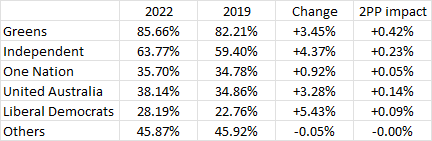
Something I really should have noted in last week’s post is that the Australian Electoral Commission has now published two-candidate preferred preference flow data from the election, showing how minor party and independent preferences flowed between Labor and the Coalition. The table below shows how Labor’s share increased for the four biggest minor parties and independents collectively (and also its fraction decrease for “others”) from the last election to this and, in the final column, how much difference each made to Labor’s total share of two-party preferred, which was 52.13%.

Note that the third column compares how many preference Labor received with how many they would have if preference flows had been last time, which is not the same thing as how many preferences they received. Labor in fact got nearly 2% more two-party vote share in the form of Greens preferences at this election because the Greens primary vote was nearly 2% higher this time.

State and territory by-election:

• Six candidates for the August 20 by-election in the Northern Territory seat of Fannie Bay, in ballot paper order: Brent Potter, described in a report as a “government adviser, army veteran and father of four”, for Labor; independent George Mamouzellos; independent Raj Samson Rajwin, who was a Senate candidate for the United Australia Party; Jonathan Parry of the Greens; independent Leah Potter; and Ben Hosking, “small business owner and former police officer”, for the Country Liberals.

• Following the resignation of Labor member Jo Siejka, a by-election will be held for the Tasmanian Legislative Council seat of Pembroke on September 10. Siejka defeated a Liberal candidate by 8.65% to win the eastern Hobart seat at the periodic election in 2019. There will also be a recount of 2021 election ballots in Franklin to determine which of the three unelected Liberals will replace Jacquie Petrusma following her resignation announcement a fortnight ago. As Kevin Bonham explains, the order of probability runs Bec Enders, Dean Young and James Walker.

• Still no sign of a date for Western Australia’s North West Central by-election.

Page 1 of 7
1 2 7