The Guardian has a report on the fortnightly Essential Research poll, from which I assume we will get voting intention numbers later today. The fact that The Age has a Resolve Strategic state poll from Victoria suggests a federal poll from that outfit should be with us shortly. For now, I can relate that the Essential poll has Anthony Albanese at 53% approval (down two on a month ago) and 34% disapproval (up three). The poll also finds 69% believe the Reserve Bank has overreacted with its interest rate increases, and 71% believe the federal government is largely or partly culpable, though it’s unclear if the question specified the current government. An even 29% believe Labor or the Coalition would do a better job managing interest rates, with 42% opting for no difference. The poll was conducted Wednesday to Sunday from a sample of 1044.
In other news, the Speaker of the House of Representatives, Milton Dick, announced yesterday that the Aston by-election will be held on the inauspicious date of April 1, which is one week after the New South Wales state election (and two after the Arafura by-election in the Northern Territory). Labor has announced that it will again field its candidate from last year’s federal election, Mary Doyle, a finance worker and former organiser for the National Tertiary Education Union, who was the only candidate to nominate. The Age reports the Liberals are taking the preselection out of the hands of their unreliable rank-and-file, which presumably shortens the odds on barrister Roshena Campbell and lengthens them on Emanuele Cicchiello, deputy prinicipal of Lighthouse Christian College.

Pi: “Which has ZERO to do with your assertion about ‘raiding’ your super. Ya just made that shit up.”
I don’t believe I’ve crossed swords with you before, but you’ve engaged in one of the most egregious forms of selective quoting I’ve ever seen.
Please redo your post and include my entire comment: you know, including the bit where I mentioned Chalmers saying that the cost of superannuation concessions was unsustainable in the long-term.
Confessions says:
Tuesday, February 21, 2023 at 8:07 am
I agree with Meher about the stage 3 tax cuts, as I’ve said here before that they need to be deferred, abolished or tweaked. I actually think the tax cuts will be tweaked by the govt instead of delivered in their current proposed state.
But we shall see.
___________________________________
It’s been a long time since ‘bracket creep’ was a thing. But with wage increases just to try and catch up with inflation it will now return as a significant taxation issue. Which is to say that the government will have to deliver tax cuts in 2024. But to the wage and salary earners most affected by inflation – which is lower to middle income earners. So there will be “Stage 3” tax cuts in 2024. They just won’t be what Morrison and co devised.
It will be eminently sellable with actual numbers and hard to oppose by the Opposition. Which is why the Coalition and their fellow travellers on the left are so keen to make it an issue NOW, when all sorts of bullshit can be put around.
Torchbearer @ #50 Tuesday, February 21st, 2023 – 8:12 am
Thank you for mentioning them. 🙂
There’s a macro as well as a micro picture to look at.
Confessions @ #51 Tuesday, February 21st, 2023 – 8:14 am
I guess I have skin in the game. I just want my son to be able to afford to buy a house and what I don’t want is a cynical Coalition policy play to force house prices to start going up and up and up again!
Don’t blame me because you don’t like getting called out for making shit up mb. You inserted the ‘raiding’ narrative
“I can expect the government to raid the money in my super account somewhere in the next 20 or so years. ”
You even went further and integrated it with commentary about pressure from Albanese. Stop doing that. If you have a case to be made, you can do it without inventing something to suit a narrative. You clearly are against the changes to super, and the only thing it looks like to me, is that you want other people to be against them. Doing that by inventing bogeymen is the work of propagandists.
https://arstechnica.com/tech-policy/2023/02/meta-tests-12-monthly-subscription-for-extra-impersonation-protection/
Yes please. More subscriptions for Facebook. The best thing that ever happened in Oz was putting murdoch behind a paywall.
AE: “While we are on the subject of toxic politics and bad policy: the tax free concessions in the property market – all of them in combination – are largely responsible for the absurd house prices. Again the ‘reward’ for that is a gift to cashed up boomers and the crumb collectors in Gen X. I’m sure meher will infarct reading this, but there you go. The policies he favours are killing both the national accounts and the hopes and dreams of a younger generation; ‘but we shall weep for the millennials’, am I right, meher.”
Not really. I agree that the current taxation treatment of housing – taken as a whole – is vastly unjust.
What I have argued against in the past is the proposition that negative gearing concessions and the current rate of capital gains tax were keeping millenials out of the housing market. They’re part of the problem, but not the main one: the absurd house prices we now see are largely the consequence of prolonged low interest rates and an unnecessary loosening of the lending standards applied by ASIC to the banking sector (now fixed, but it’s a case of shutting the door after the horse has bolted).
And, as I noted in an earlier post, it’s no good fixating on negative gearing and capital gains tax and then ignoring the issue of the completely tax free status of capital gains on owner-occupied housing. A sensible reform strategy for housing taxation needs to be wholistic.
Moreover, if you were to remove negative gearing instantly, in the way that Shorten promised to do in 2019, the consequences for the rental market would be pretty dire. A much better idea would have been to limit the concessions to one investment property per taxpayer. Labor didn’t want to do this because that wouldn’t have raised enough additional revenue to pay for all the other things they wanted to do.
The desire to raise lots of additional revenue is almost inevitably detrimental to taxation reform.
Good article in The Guardian about the environmental impact of Russia’s invasion of Ukraine:
“ Toxic smoke, contaminated rivers, poisoned soil, trees reduced to charred stumps, nature reserves pocked with craters: the environmental toll from Russia’s war with Ukraine, which has been detailed in a new map, might once have been considered incalculable.
But extensive investigations by Ukrainian scientists, conservationists, bureaucrats and lawyers are now under way to ensure this is the first conflict in which a full reckoning is made of environmental crimes, so the aggressor can be held to account for a compensation claim that currently stands at more than $50bn (£42bn).”
https://www.theguardian.com/world/2023/feb/20/ukraine-war-cost-for-nature-russia
Pi: “ou clearly are against the changes to super, and the only thing it looks like, is that you want other people to be against them. Doing that by inventing bogeymen is the work of propagandists.”
But I’m in favour of the idea of forcing the small number of people with massive superannuation balances to take their money out and invest it somewhere else. And I’m also supportive of the idea that people can’t withdraw money from their super before they retire, and was merely expressing my understanding that some millenials might not trust the government to keep its hands off their money.
My original point was that Chalmers was going well with his proposed superannuation reforms, but now seems to have chosen to open up a risky new front. The more I think about it, the more I suspect it’s deliberate and relates to the government having great difficulties in developing a credible 2023-24 budget while also finding enough money to pay for the new things they desperately want to introduce.
If Albo doesn’t intervene in the debate today, then my suspicions might be confirmed.
#weatheronPB
Uninspired grey,
stretched as far as I can see.
At least it’s not hot.
abc730
@abc730
Noel Pearson says he is “absolutely appalled” by Tony Abbott’s opposition to the Voice.
“He was a very strong advocate for constitutional recognition when he was Prime Minister. As with a lot of things he has changed his view after losing the Prime Ministership.” #abc730
https://twitter.com/i/status/1627592041231450113
and was merely expressing an understanding that some people might not trust the government with their money.
They’re not giving ‘their money’ to the government, they’re giving it to a Super fund to hold and invest for them so that they can have a comfortable, not a penurious, retirement!
People hyperventilating about Chalmers throwing the super issue into the air for debate seemed to have missed the new culture we have in Canberra, where issues are opened to debate and discussion in the broader community.
This seems to be about the tenth issue people say the Labor Govt have botched because they have treated us all as adults, able to discuss something openly. There are risks, but the government has so far managed to run a country of more informed adults well so far.
The days of the PM turning up, making a shouty pronouncement in front of ten flags and then disappearing are over.
mb
My original point was that Chalmers was going well with his proposed superannuation reforms, but now seems to have chosen to open up a risky new front. The more I think about it, the more I suspect it’s deliberate and relates to the government having great difficulties in developing a credible 2023-24 budget while also finding enough money to pay for the new things they desperately want to introduce.
_____________________________________
Every new government comes into office or is re-elected with an injection of political capital. The question is how to use it most wisely. You may be right that Chalmers has not used it wisely but the disproportionate superannuation concessions to those who need it least have to be addressed.
I think the coming budget will address concessions for super accounts with outrageous amounts of money in them (there seems to be consensus that $5 million is a benchmark) but he is right that there is a need to define what superannuation is for.
And after watching hours of robodebt RC testimony the sickening appeal to looking after taxpayers money as a justification for driving poor people to suicide it might be time to actually look to how we can stop wasting so much money on very rich people.
Torchbearer @ #64 Tuesday, February 21st, 2023 – 8:40 am
Thank goodness.
Also, hopefully, the days of News Corp directing and monopolising the conversation talking points, are over.
Putrid Vladimir Putin is an evil individual with a sick mind:
https://youtu.be/1HePye0GA6g
@meher:
“ the main
one: the absurd house prices we now see are largely the consequence of prolonged low interest rates and an unnecessary loosening of the lending standards applied by ASIC to the banking sector (now fixed, but it’s a case of shutting the door after the horse has bolted).”
_____
Shenanigans.
I brought our first home in 1997 – a a 2br semi on a busy road in Croydon Park. We sold it seven years later for triple the money. Sure we put ~ 100K in renovations into the property, but our neighbours – who brought the otherside of the semi just after us and sold just before we did – didn’t do as extensive a series of improvements and yet still got a comparable capital gain.
I recall being in Paris 18 months before we sold up and there were three br roof top apartments going on the Rue de Rivoli overlooking the Tuilevies that were going for half the price that my inner west semi would have got on the market in 2003.
In 2004 we sold and upgraded to the smallish 3br bungalow we still live in in Earlwood. Even before those ‘emergency’ interest settings came into being, our property tripled in value in under 15 years.
On trimming Superannuation tax concessions, putting a cap on the unlimited favourable tax treatment of SMSF in the accumulation phase is long overdue.
A $5m cap has been suggested, with earnings over that number to be taxed at marginal rates – though looking at the Top 10 holdings in SMSF, the accumulated amounts are eye watering…
Jim Chalmers is proposing legislated objectives for super.
He could also consider a statement what super is NOT meant for – tax evasion as per the SMSF scam
BK thanks for your daily news roundup
Robodebt was designed to make Liberal supporters feel smug about themselves, shaking off the debtors bleats as “they had what’s coming to them”
1 Liberal voting mother paid off daughters debt believing that her daughter did nothing wrong but everyone else did
Another mother who supports her son $1000 per month thought that governments couldn’t possibly dun vulnerable people for false debts
==> the dole bludger trope still lives, even though
under 1% unemployment payments are fraud
> 50% unemployed are unemployed for > 5 years and are over 50
high % unemployed have been rejected for higher paying DSP
Robodebt dunned 1 in 20 working age Australians, many of the unaffected still believe the dunned were overpayed, including the Minister for Social Services Bill Shorten who relies on senior DSS executives who say there are 17% overpayments which the department is clawing back from years ago
BIG PROBLEM
Tudge evidence showed that 96% of errors caused by customer or Centrelink staff error – why were the causes combined?
Counter staff are now on 3 month contracts through labour hire companies like SERCO, waste of time to spend a week training them. They are inputting data into a legacy system which collects transactions, runs them in batch against the legacy IBM style database (see male nerdy public servant testimony from Dec)
How did executives decide there have been 17% overpayments, another witness said the SAP system used by the executives “has a very poor interface” with the legacy database
It’s more likely 17% over and UNDER payments
Is DSS or DHS or Services Australia trying to recoup money from more than 3 years ago, STOP IT
Is DSS or DHS or Services Australia reversing onus of proof onto clients, STOP IT
Meanwhile the for profit companies in the welfare-to-work industry continue to prosper as they police and arbitarily punish the welfare recipients pushed into their grasping maws. They do not find jobs they game the system and make their owners rich
It would be a shame if Labor botched the super debate – again.
Tax the $5m+ accounts at marginal tax rates and dont go beyond that. After all Labor’s ill advised franking credits policy ended up giving those $5m plus people another 5 years of the rort.
Going after more just allows it be an argument about a revenue grab which they’ll lose. Maybe go back to the drawing board and dust off the Henry Tax Review and look at that? How much was ever implemented in the last decade?
UK Cartoons:


Patrick Blower on #RoaldDahl
Guy Venables on #railways #Ukraine
Martin Rowson on the battle over the Northern Ireland protocol
Matt on #RoaldDahl
Steven Camley on #LancashirePolice #NicolaBulleyCase
Christian Adams on #RishiSunack #BorisJohnson
Fergus Boylan on #RishiSunack #BorisJohnson
Morten Morland on #RishiSunak #BorisJohnson #northernirelandprotocol
c@t: “Noel Pearson says he is “absolutely appalled” by Tony Abbott’s opposition to the Voice.
“He was a very strong advocate for constitutional recognition when he was Prime Minister. As with a lot of things he has changed his view after losing the Prime Ministership.” #abc730″
Is Pearson being disingenous do you think, or is he simply naive?
Despite his tendency to display a certain amount of noblesse oblige towards Indigenous communities, Abbott has always adopted extremely right-wing positions on Indigenous matters. As an example from the mid-2000s, which was exactly when Abbott was cosying up to Pearson.
Mr Abbott told a Canberra conference that self-determination had failed Aborigines and”a form of paternalism … based on competence rather than race is really unavoidable if these places are to be well run…Vesting authority in an administrator makes sense but only when combined with the power to take decisions and make them stick. Someone has to be in charge.” (NB: his use of the word “paternalism” even grated with Howard, who admonished him for using it).
I don’t think it’s Abbott who has changed so much as Pearson.
In all the arguments about the tax benefits for landlords, I don’t understand why deductions for building depreciation are never mentioned.
A 2.5% deduction p.a. over 40 years because the value of ageing buildings in Sydney decline by this amount? Really?
The tax loss because of this is substantial
Meher baba
“ the main
one: the absurd house prices we now see are largely the consequence of prolonged low interest rates and an unnecessary loosening of the lending standards applied by ASIC to the banking sector (now fixed, but it’s a case of shutting the door after the horse has bolted).”
This statement is provably false. I could give similar personal anecdotes to Andrew Earlwood, but the overall data is the real proof.
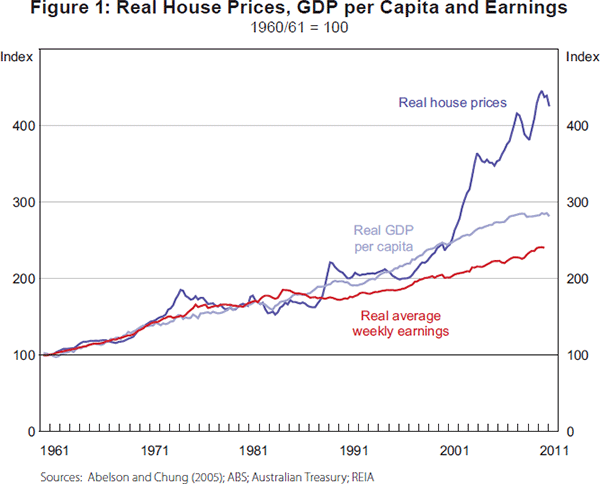
Interest rates were low throughout the 1990s to present, as they were through the 1930s, 1950s-60s and post the GFC. Yet if you plot real house prices adjusted for inflation, the house price rise post 2000 is without historical precedent in Australia. The population growth rate during the post war migration boom was higher than now, but house prices tracked with inflation. The only thing that explains the decoupling of house prices and wages in Australia since 2000 is negative gearing combined with no capital gains tax.
Meher Baba said:
I think Chalmers was ill-advised making the comment comparing the cost of superannuation to the cost of aged pensions (particularly given that the cost of superannuation is measured in terms of tax expenditures, which are not the easiest thing to explain to the average voter)
It’s the easiest way to compare the unfairness of tax concessions into superannuation which only benefit the top 10% or 5% of income earners and the aged pension costs which are expected to support 80% of the population over age 67
Gone are the halcyon days of Hawke’s full employment, from school leavers to retirement, when Keating dreamt up the superannuation system. These days people work contracts and casually from finishing school until about age 28, then there is a period of permanent full time employment until age 45 to 50 when a younger person is employed as they have developed workplace injuries or their skill set is superseded or their youthful looks are gone
A mature unemployed worker has to deplete their savings before they are eligible for unemployment benefits and will be told to sell their house, they will be forced to attend a job service provider staffed by hairdressers if you are lucky who have right to stop your payments and force you to do demeaning work for the dole in order to collect below poverty line payment
I want to see:
age pension age reduced to 60
unemployment benefits raised to Henderson poverty line
job service providers abolished
Socrates not sure of the rationale for
The only thing that explains the decoupling of house prices and wages in Australia since 2000 is negative gearing combined with no capital gains tax.
Negative gearing for investment and no CGT for housing have existed forever – they were not inventions of C21
Housing Victoria demolished 400 dwellings completed in 1976 in Prahran and replaced them with 24 apartments in South Yarra
REALLY, its cheaper to renovate the 400 dwellings
HOW MANY HOMELESS PEOPLE SLEEP ON THE STREET OUTSIDE DEMOLISH BUILDINGS EACH NIGHT?
OC
In 2001 Costello changed the tax rules, in a panic over declining retirement incomes from lower share market earnings after the Asian financial crisis. He abolished the CGT for negative geared investment property. Before you either paid CGT or didn’t get negative gearing. The combination opened the floodgates.
You can change the timescale you look at and you still get the same result. Peter Costello killed the first home buyers market in 2001.
Meher Baba stirred the pot this morning
House prices in Melbourne remained the same from about 1890 until 1961, around $3000
where $ = pounds
In 1960s rent controls imposed in World War 2 were lifted, mortgages no longer restricted to properties under 30 years old
People usually bought a house for 3 times the gross annual salary of the male partner
You can get your superannuation out now to buy a house. Just not one you can actually call home.
Take super and put it into SMSF (criminal that these things are allowed). Use the SMSF to purchase investment property. The weird thing about that arrangement is that you it just further inflates the ponzi scheme of the housing market and the net benefit of having a secure home is denied cause it has to be an investment property.
Ive no problem with SMSF super not being used for property at all (or any personal super) but dont run an ill defined campaign of we are tightening up when you can get it with random thoughts about increased undefined taxes. Disaster of a messaging strategy as is being played out today.
Friendly Jordies has been ruminating.
https://www.youtube.com/watch?v=PF1-1CNggQA
“He abolished the CGT for negative geared investment property.”
So an investor can make tax losses on the income side of the investment and not pay any CGT on capital profits. Where can I get some of this?
Socrates: “Interest rates were low throughout the 1990s to present, as they were through the 1930s, 1950s-60s and post the GFC. Yet if you plot real house prices adjusted for inflation, the house price rise post 2000 is without historical precedent in Australia. The population growth rate during the post war migration boom was higher than now, but house prices tracked with inflation. The only thing that explains the decoupling of house prices and wages in Australia since 2000 is negative gearing combined with no capital gains tax.”
Nice try, but nope. First of all, you need to compare house prices to average household earnings, not individual weekly earnings. The 1970s onwards brought a one-off structural change to average household earnings as women almost universally stayed in the workforce after marriage and also increasingly returned to work after childbirth. Banks at first were reluctant to recognise all of a wife’s income in assessing applications for loans, but this reluctance disappeared during the 1980s. This was also the period of banking deregulation that has subsequently made it much easier for ordinary households to borrow much, much more for housing, including for investment properties.
Negative gearing dates back to at least the 1950s, but used to be much more difficult for most people to access due to the much tighter restrictions on lending.
Capital gains tax didn’t even exist until 1985. The changes introduced by Howard from a discount based on cumulative inflation to a straight 50 per cent reduction were certainly more favourable to investors in rental housing – particularly those looking to buy and sell quickly to take advantage of short-term price increases – during the low inflation years of the 2000s and 2010s, but will probably be less so in the period of higher inflation that we might reasonably expect over the next decade or two. But I don’t think they were of critical importance relative to the much greater availability of mortgage funds.
I think that, like many media commentators (several of whom don’t even seem to understand that Howard didn’t actually introduce the CGT discount, but simply changed how it was calculated), you are significantly overrating the effects of tax policies on the housing market. If you are correct, then the value of predominantly rental forms of housing such as apartments would have grown much faster than that of new outer-suburban freestanding houses. I have seen no such evidence of such a trend: indeed, my impression is that the market for apartments is far more volatile than that for freestanding houses.
To sum up, I still consider that the main problem with the housing market is that there is far too much money sloshing around in it. Tax policies certainly make a difference at the margins, but are not the main issue.
I wouldn’t support Govt directly taking super in accounts, but a cap that had excess fully taxed at the top marginal rate annually would be fine.
Also using super as an intergenerational transfer mechanism, so if the money isn’t going into a super annuation account of the beneficiary preserved til retirement, tax any intergenerational transfers over 1/4 of the cap at the top marginal rate.
I’d also start with the home, if a home is sold within 5 years of being inherited then tax the lesser of the capital gain at 50% or 25% of the value at 50%.
Shellbell
Negative gearing and the CGT discount classic case of double dipping.
I say have one or the other.
Maybe an investor could choose when embarking on the project.
That would sort the savy from fools.
News to me, my memory is that CGT at marginal rate for rental property started in 1985 but was discounted for the effects of inflation (significant in those days). At some stage Howard said this was all too difficult and CGT was instead discounted by 50% if property was held for more than one year and not used as primary residence in the previous 6 years
I admit I may have missed a policy inbetween
The 50% discount on CGT must be becoming less attractive in a high inflation environment
Blog Intro
The poll also finds 69% believe the Reserve Bank has overreacted with its interest rate increases, and 71% believe the federal government is largely or partly culpable, though it’s unclear if the question specified the current government.
_____________________
Current government I would say William.
I see Meher Baba is unwilling to admit error but for the benefit of anyone with a genuine interest:
– nothing changed about the trend of women working and household incomes around 2001 to explain the massive shift in real home prices. 2 income families were the norm since the 1970s.
– The CGT/negative gearing combo kept house prices in reasonable balance till Costello effectively abolished the CGT on negative geared investment property in 2001.
And here is another RBA graph with real household incomes included. Still see the massive rise from 2001 on. This issue has been studied to death and it is shameful anyone tries to deny the cause now.
OC
Yes it was that Howard change in 2001 I was referring too. It entrenched investment buyers as the main driver of house prices in Australia.
Shellbell @ #83 Tuesday, February 21st, 2023 – 9:13 am
I am confused too.
But perhaps the misspeak leads us to what ross is suggesting – you get the CGT discount or the negative gearing on investment property. Not both. Is that right?
Taylormade @ #90 Tuesday, February 21st, 2023 – 9:54 am
Sorry, no cigar, Taylormade. 42%, the majority, believe neither Labor nor the Coalition would have made a difference to managing interest rates. Which goes to the fundamental question of who are the better economic managers, usually a Coalition staple. So I think the conclusion you can draw from that is that people know who caused the problem.
What the heck happened around the year 2000?
The First Home Owners Grant….
Then then 2008 spike occurred with the First Home Owners Boost.
Weren’t those policies supposed to make housing “More Affordable???”
To sum up, I still consider that the main problem with the housing market is that there is far too much money sloshing around in it.
And in one short sentence you have destroyed the whole argument you have spent the morning building up, meher baba.
Because allowing young people to put their Super into buying a house will only contribute to too much money sloshing around the housing market. 😐
Alpha Zero @ #94 Tuesday, February 21st, 2023 – 10:00 am
And it’s the same con the Conservatives are trying on now with the Super into a Home Deposit scam. All for the benefit, not of First Home Buyers but the wealthy Investment Property/Home Owning base of the Liberal Party.
billie,
You’ve been on fire this morning! More power to you!
Torchbearersays:
Tuesday, February 21, 2023 at 8:40 am
The days of the PM turning up, making a shouty pronouncement in front of ten flags and then disappearing are over.
_____________________
You seem to have missed the FIFO visit to Alice Springs a few weeks ago.
Rumour is they didn’t even turn the planes engines off, just left it running on the tarmac.
Pisays:
Tuesday, February 21, 2023 at 8:24 am
Keep up the good fight:).
The LNP and their handlers see the debate on super as a chance to rerun the dishonest franking credit debate.
Already we see people with super balances well under $1.7 mil getting all hot and bothered. Duped into the belief the government is coming after them.
Mr Chalmers has not said anything that is not sound common sense. Defining the purpose of super is long overdue.
Looks like stooge summer is coming to an end .
I note that there is definitely a downturn in housing numbers and value in the East. Not so here. I am taking a closer interest in what is happening on a few properties around the traps (beyond what I do for work). Buyers seem desperate, they are taking their chances on what I see as overvalued properties. Even the recent announcement by the state government of the intended release of large developments isnt slowing this as peeps know that is many years away. I have been thinking about this – and my own situation back in Sydney when prices went bonkers. I chose to rent and invest in shares – then buy in Adelaide where it was cheapo. With rental prices as they are this isnt an option for people wanting to buy. I am starting to settle into a position the problem and hence the solution is rental prices. The people winning these overvalued local properties are often investors – not the first home owners. But the first homeowners are the bulk of the people at the auctions – and some will stretch themselves in their desperation. There is a vicious cycle here.
On another note, the state Liberals have officially come out against the state Voice. They seem to have rolled out their least capable spokesperson to try to explain it. Poor Josh, I like him but he isnt up to this.