I don’t particularly claim to be an authority on US politics, so what follows is anything but a definitive guide. If nothing else though, writing it has been a useful way to get my own thoughts in order concerning next Tuesday’s mid-term elections, for which we should start to see results around noon on Wednesday, Sydney and Melbourne time.
In the House of Representatives, Nate Silver’s poll tracker has the Democrats leading on the “generic ballot” measure by 51.0% to 42.2%, while Patrick Ruffini’s model projects to a Democratic majority of 233 to 202. This is reflected in prediction markets, with Polymarket putting the probability of a Democratic majority at 91%.
Ruffini’s model is packaged for subscribers into a nifty “Swingometer” feature that the user can adjust in various ways. Much like the Mackerras pendulums familiar to election watchers in Australia, Ruffini’s model lists seats from bluest to reddest, taking into account the changes in nine states whose maps have been redrawn. This is based on vote share in the presidential rather than House election, producing base party vote shares on an apples-to-apples basis.
In all of the analysis that follows, I am citing Ruffini’s party vote estimates off the 2024 baseline, in which the Republicans had an overall advantage of 1.5% (reflecting Donald Trump’s 49.8% to 48.3% win over Kamala Harris on the popular vote), with all the incumbency and other adjustments Swingometer allows for set at zero. On this scenario, the Republicans win 234-201 — a gain of 14 seats on their actual result in 2024. Ten of the 14 can be put down to redistricting, but four represent the net effect of turning off incumbency advantages.
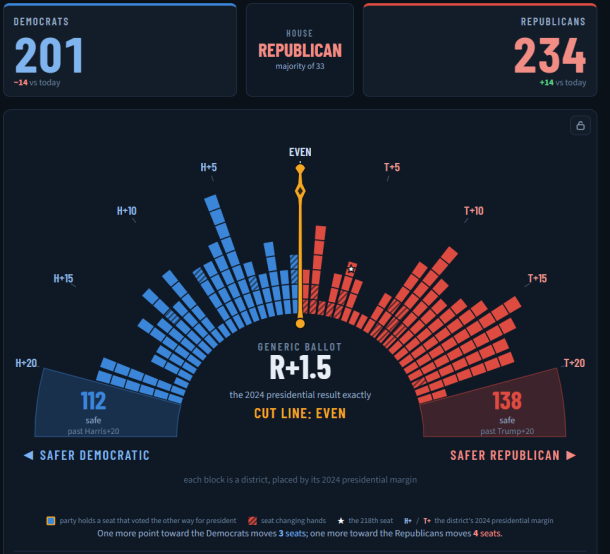
Moving the needle 1.5% to the right for a result of 50-50 reduces the Republican advantage only as far as 228 to 207. To get to the point marked on Mackerras pendulums as “swing required for majority”, the Democrats need to be winning the vote by 53.2-46.8. Under my no-frills settings, the 8.2% Democratic advantage calculated by Ruffini gets the Democrats to 230-205, which isn’t much different from the 233-202 Ruffini gets after pricing in candidate-related adjustments.
The effects of gerrymandering are evident in the relative paucity of Republican seats to be found between “EVEN” and 9% on the right side of the pendulum. Of the six states where maps have been redrawn by Republican-controlled legislatures, the Democrats need swings of more than 10% to gain any of the 30 notionally Republican seats in Texas; 9.2% to gain any out of 23 in Florida; 9.6% to gain any out of 11 in North Carolina; and they stand no chance of gains in Louisiana, Alabama or Tennessee.
Once the swings hit double-digits, gerrymandering starts to backfire: the process involves a party cutting its margins in strong seats to shore it up elsewhere, leaving few truly safe seats to fall back on when the wave becomes tidal. The Republicans have three seats in the 10% to 11% range in Texas; six between 10% and 15% in Florida; and four between 9% and 14% in North Carolina. The Democrats’ retaliatory gerrymander in California, endorsed by that state’s voters at a referendum, locks up Republican support in four of the state’s 52 districts with margins of between 12.6% and 33.0% (plus one Republican marginal at 1.9%), whereas eight seats have notional Democratic margins in single-digits.
Then there is the Senate, which must be reckoned on a case-by-case basis. Senators serve six-year terms over a staggered cycle in which a third are up for election every two years, with two-thirds of the states electing one of their two Senators at any given election. To this are added special elections for seats that have been warmed by placeholders since J.D. Vance resigned his Ohio seat to become Donald Trump’s running mate and Marco Rubio abandoned his seat in Florida to become Secretary of State.
Of the seats not up for election, 32 are held by Democrats, 31 by Republicans and two by independents – the latter caucus with the Democrats, but are balanced somewhat by the maverick tendencies of Pennsylvania Democrat John Fetterman. There is also the possibility, rated at 29% by Polymarket, that Republican incumbent Pete Ricketts will be unseated in Nebraska by Dan Osborn, an independent who says he will not caucus with either party.
The Democrats broadly defined can thus get to 50-50 if they win 16 of the 35 seats up for election, though the Vice-President’s casting vote means parity would little avail them. Seventeen will be required for an effective majority, and 18 for one that is Fetterman-proof. The presumption for most of the past two years has been that this task would be beyond them, as 22 of the 35 seats up for election are Republican-held. However, such has been the decline in the electoral standing of the President and his party that Polymarket now rates the Democrats a 63% chance of pulling it off.
The nine Democratic incumbents seeking re-election are presumably safe, as are the candidates seeking to succeed retiring members in Illinois, Minnesota and New Hampshire. However, the adventurous choice of Abdul El-Sayed to succeed Gary Peters means Michigan requires keeping an eye on, with Polymarket rating El-Sayed’s chances at 69%. The key Republican-held seats are as follows:
North Carolina. The lowest-hanging fruit for the Democrats, being a swing state in which incumbent Thom Tillis is retiring. Polymarket gives Democrat Roy Cooper a 96% chance of gaining the seat.
Maine. A Democratic-leaning state where defending member Susan Collins has held her ground since 1997, having been one of the two most moderate members of the Republican Senate contingent along with Lisa Murkowski from Alaska. Polymarket puts her chances of extending her winning run at 40%.
Texas. The Republicans look to have dealt Democratic candidate James Talarico into the game by dumping incumbent John Cornyn in favour of the tarnished Ken Paxton, in part due to insufficient sycophancy towards the President. Polymarket has Talarico the favourite at a probability of 68%.
Ohio. In a once finely balanced state that Donald Trump won on a double-digit margin in 2024, Polymarket gives Democratic challenger Sherrod Brown a 68% chance against Republican incumbent Jon Husted.
Alaska. Democratic candidate Mary Peltola has lately edged into favouritism against Dan Sullivan in Alaska, with Polymarket rating her a 73% chance. However, intensifying suggestions that the Democratic camp was behind a dumb trick to confuse voters by persuading another Dan Sullivan to add his name to the ballot paper will make late polling especially worth keeping an eye on.
Iowa. Barack Obama won this state twice, but it has come down heavily for Donald Trump three times since. However, the prevailing tide and the retirement of Republican incumbent Joni Ernst means the markets are rating Democratic candidate Josh Turek at nearly level pegging against Republican candidate Ashley Hinson.
Kansas. In a state where the Democrats last won a Senate election in 1932, Polymarket gives Adam Hamilton a 40% chance of unseating Republican incumbent Roger Marshall.
South Carolina. Darline Graham was appointed in July to fill the vacancy created by the death of Lindsey Graham, her brother and inheritor of the family brain cell. Polymarket gives her a 74% chance of having her positioned confirmed by voters ahead of Democratic candidate Annie Andrews.
Florida. Despite the state’s marked shift rightward over the past decade, it might be assumed in the current circumstances that Florida would be in play, but all indications are that Republican incumbent Ashley Moody will be safely returned.
Governor’s races add an extra layer of interest to those who are deeper into the weeds of US politics than I am, but the only one I personally will be paying much attention to is Ohio, where Democrat Amy Acton must defeat Republican Vivek Ramaswamy for the sake of whatever is left of decency in American public life.

I wonder what the approval ratings look like in each of those states
I remember in 2024 comparing the approval ratings of Trump and Harris as a predictive tool was weirdly accurate.
Different country, but still fairly relevant, if you compared Albo’s approval rating of 42% in the final newspoll with Dutton’s approval rating of 32%, take off 50% of the margin because of preferential voting, you’d get 55-45 to Labor, spot on
@Arange
Oh, I can give you the numbers, from the NYTimes/Siena poll
Iowa Trump Approval
Approve: 34%
Disapprove: 60%
Maine Trump Approval
Approve: 35%
Disapprove: 60%
Texas Trump Approval
Approve: 41%
Disapprove: 55%
Michigan Trump Approval
Approve: 34%
Disapprove: 60%
Ohio Trump Approval
Approve: 38%
Disapprove: 57%
Kansas Trump Approval
Approve: 40%
Disapprove: 56%
Alaska Trump Approval
Approve: 40%
Disapprove: 55%
I seem to remember the Dem candidates also having approval ratings in the NYT polls?
@Arange
Looking further, yes, I see the approval ratings for the Senate candiates.
Maine Senate:
Troy Jackson (D): 45% Favourable, 48% Unfavourable
Susan Collins (R): 48% Favourable, 49% Unfavourable
Texas Senate:
James Talarico (D): 49% Favourable, 39% Unfavourable
Ken Paxton (R): 33% Favourable, 54% Unfavourable
Michigan Senate:
Abdul El-Sayed (D): 50% Favourable, 38% Unfavourable
Mike Rogers (R): 37% Favourable, 49% Unfavourable
Iowa Senate:
Josh Turek (D): 49% Favourable, 34% Unfavourable
Ashley Hinson (R): 43% Favourable, 43% Unfavourable
Ohio Senate:
Sherrod Brown (D): 46% Favourable, 44% Unfavourable
Jon Husted (R): 36% Favourable, 48% Unfavourable
Kansas Senate:
Adam Hamilton (D): 48% Favourable, 39% Unfavourable
Roger Marshall (R): 39% Favourable, 50% Unfavourable
Alaska Senate:
Mary Peltola (D): 47% Favourable, 42% Unfavourable
Dan Sullivan (R): 41% Favourable, 48% Unfavourable
Thanks
Shifting Kansas from Safe R to Likely R
Safe D 49
Likely D 3
Likely R 2
Safe R 46
Likely D:
Iowa
Minnesota
South Carolina
Likely R:
Kansas
Michigan
Trump regime killed people on the street, shown unimaginable cruelty to people living in US, imposed tariffs, involved in open corruption but the MAGA and Trump voters did not budge. They did not budge even during initial months of Iran war.
Even Epstein files. They get agitated when Trump says boys go to schools and come back to home as girls.
But it appears rise in petrol and diesel prices is the red line that Trump should not have crossed.
I’m on the fence re Graham, but otherwise I can pretty much get behind these predictions.
My 2 bobs worth.
Dems 241 Reps 194 in the House
Dems 52 Reps 48 in the senate
My prediction:
House: Democrats 237, Republicans 198
Senate: Democrats 53, Republicans 47
Wild U.S. midterm prediction:
Democrats 250/54
And then all hell is going to break loose.
I had no idea about some of the details in the NYT final polls.
Michigan and Kansas likely Dem,
Senate 54-46 to Dems
My prediction for tomorrow:
Dems 235 Reps 200 in the House
Dems 51. Reps 49 in the senate
Predictions tally update:
(name, Dem house seats, GOP house seats, Dem senate seats, GOP senate seats)
TBM 258, 177, 54, 45
MMM 252, 183, 54, 46
SF 250, 185, 54, 46
Daniel T 247, 188, 55, 45
LOTY 246, 189, 53, 47
Bonza 245, 190, 55, 45
HS 244, 191, 53, 47
DoubleD 242, 193, 55, 45
Meher 241, 194, 54, 46
Seadog 241, 194, 52, 48
newy boy 240, 195, 54, 46
Confessions , , 53, 47
yabba 240, 195, 52, 48
Arange 239, 196, 54, 46
dyno 237, 198, 53, 47
DRDR 237, 198, 53, 47
Bean , , 52, 48
Mavis 237, 198, 51, 49
Dr F McS 236, 199, 52, 48
Hugo 235, 200, 54, 46
Socrates 235, 200, 51, 49
Imacca 233, 202, 54, 46
Ross 233, 202, 53, 47
Toorak Toff 232, 203, 53, 47
BK 231, 204, 51, 49
BW 231, 204, 51, 49
Kirs 230, 205, 53, 47
Nadia 230, 205, 50, 50
Prediction:
House; Dems 243; Rep 192
Senate; Dems 56; Rep 44
Blue Tsunami!
Actually I change my house prediction to 240 to Dems.
Spent a whole month watching the house and ended up exactly where I started, haha
New thread.