I don’t particularly claim to be an authority on US politics, so what follows is anything but a definitive guide. If nothing else though, writing it has been a useful way to get my own thoughts in order concerning next Tuesday’s mid-term elections, for which we should start to see results around noon on Wednesday, Sydney and Melbourne time.
In the House of Representatives, Nate Silver’s poll tracker has the Democrats leading on the “generic ballot” measure by 51.0% to 42.2%, while Patrick Ruffini’s model projects to a Democratic majority of 233 to 202. This is reflected in prediction markets, with Polymarket putting the probability of a Democratic majority at 91%.
Ruffini’s model is packaged for subscribers into a nifty “Swingometer” feature that the user can adjust in various ways. Much like the Mackerras pendulums familiar to election watchers in Australia, Ruffini’s model lists seats from bluest to reddest, taking into account the changes in nine states whose maps have been redrawn. This is based on vote share in the presidential rather than House election, producing base party vote shares on an apples-to-apples basis.
In all of the analysis that follows, I am citing Ruffini’s party vote estimates off the 2024 baseline, in which the Republicans had an overall advantage of 1.5% (reflecting Donald Trump’s 49.8% to 48.3% win over Kamala Harris on the popular vote), with all the incumbency and other adjustments Swingometer allows for set at zero. On this scenario, the Republicans win 234-201 — a gain of 14 seats on their actual result in 2024. Ten of the 14 can be put down to redistricting, but four represent the net effect of turning off incumbency advantages.
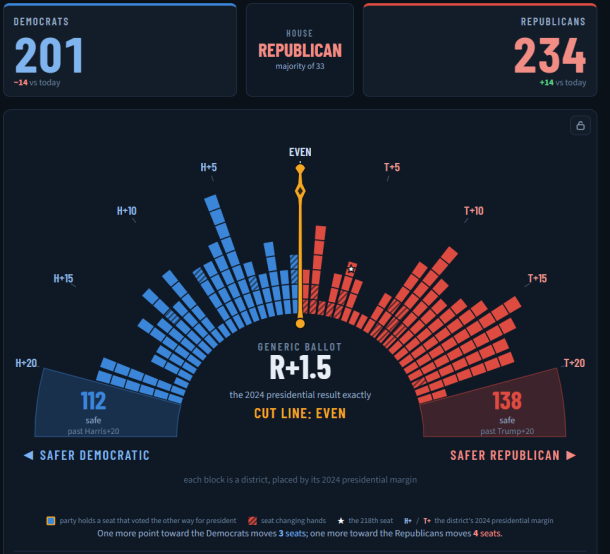
Moving the needle 1.5% to the right for a result of 50-50 reduces the Republican advantage only as far as 228 to 207. To get to the point marked on Mackerras pendulums as “swing required for majority”, the Democrats need to be winning the vote by 53.2-46.8. Under my no-frills settings, the 8.2% Democratic advantage calculated by Ruffini gets the Democrats to 230-205, which isn’t much different from the 233-202 Ruffini gets after pricing in candidate-related adjustments.
The effects of gerrymandering are evident in the relative paucity of Republican seats to be found between “EVEN” and 9% on the right side of the pendulum. Of the six states where maps have been redrawn by Republican-controlled legislatures, the Democrats need swings of more than 10% to gain any of the 30 notionally Republican seats in Texas; 9.2% to gain any out of 23 in Florida; 9.6% to gain any out of 11 in North Carolina; and they stand no chance of gains in Louisiana, Alabama or Tennessee.
Once the swings hit double-digits, gerrymandering starts to backfire: the process involves a party cutting its margins in strong seats to shore it up elsewhere, leaving few truly safe seats to fall back on when the wave becomes tidal. The Republicans have three seats in the 10% to 11% range in Texas; six between 10% and 15% in Florida; and four between 9% and 14% in North Carolina. The Democrats’ retaliatory gerrymander in California, endorsed by that state’s voters at a referendum, locks up Republican support in four of the state’s 52 districts with margins of between 12.6% and 33.0% (plus one Republican marginal at 1.9%), whereas eight seats have notional Democratic margins in single-digits.
Then there is the Senate, which must be reckoned on a case-by-case basis. Senators serve six-year terms over a staggered cycle in which a third are up for election every two years, with two-thirds of the states electing one of their two Senators at any given election. To this are added special elections for seats that have been warmed by placeholders since J.D. Vance resigned his Ohio seat to become Donald Trump’s running mate and Marco Rubio abandoned his seat in Florida to become Secretary of State.
Of the seats not up for election, 32 are held by Democrats, 31 by Republicans and two by independents – the latter caucus with the Democrats, but are balanced somewhat by the maverick tendencies of Pennsylvania Democrat John Fetterman. There is also the possibility, rated at 29% by Polymarket, that Republican incumbent Pete Ricketts will be unseated in Nebraska by Dan Osborn, an independent who says he will not caucus with either party.
The Democrats broadly defined can thus get to 50-50 if they win 16 of the 35 seats up for election, though the Vice-President’s casting vote means parity would little avail them. Seventeen will be required for an effective majority, and 18 for one that is Fetterman-proof. The presumption for most of the past two years has been that this task would be beyond them, as 22 of the 35 seats up for election are Republican-held. However, such has been the decline in the electoral standing of the President and his party that Polymarket now rates the Democrats a 63% chance of pulling it off.
The nine Democratic incumbents seeking re-election are presumably safe, as are the candidates seeking to succeed retiring members in Illinois, Minnesota and New Hampshire. However, the adventurous choice of Abdul El-Sayed to succeed Gary Peters means Michigan requires keeping an eye on, with Polymarket rating El-Sayed’s chances at 69%. The key Republican-held seats are as follows:
North Carolina. The lowest-hanging fruit for the Democrats, being a swing state in which incumbent Thom Tillis is retiring. Polymarket gives Democrat Roy Cooper a 96% chance of gaining the seat.
Maine. A Democratic-leaning state where defending member Susan Collins has held her ground since 1997, having been one of the two most moderate members of the Republican Senate contingent along with Lisa Murkowski from Alaska. Polymarket puts her chances of extending her winning run at 40%.
Texas. The Republicans look to have dealt Democratic candidate James Talarico into the game by dumping incumbent John Cornyn in favour of the tarnished Ken Paxton, in part due to insufficient sycophancy towards the President. Polymarket has Talarico the favourite at a probability of 68%.
Ohio. In a once finely balanced state that Donald Trump won on a double-digit margin in 2024, Polymarket gives Democratic challenger Sherrod Brown a 68% chance against Republican incumbent Jon Husted.
Alaska. Democratic candidate Mary Peltola has lately edged into favouritism against Dan Sullivan in Alaska, with Polymarket rating her a 73% chance. However, intensifying suggestions that the Democratic camp was behind a dumb trick to confuse voters by persuading another Dan Sullivan to add his name to the ballot paper will make late polling especially worth keeping an eye on.
Iowa. Barack Obama won this state twice, but it has come down heavily for Donald Trump three times since. However, the prevailing tide and the retirement of Republican incumbent Joni Ernst means the markets are rating Democratic candidate Josh Turek at nearly level pegging against Republican candidate Ashley Hinson.
Kansas. In a state where the Democrats last won a Senate election in 1932, Polymarket gives Adam Hamilton a 40% chance of unseating Republican incumbent Roger Marshall.
South Carolina. Darline Graham was appointed in July to fill the vacancy created by the death of Lindsey Graham, her brother and inheritor of the family brain cell. Polymarket gives her a 74% chance of having her positioned confirmed by voters ahead of Democratic candidate Annie Andrews.
Florida. Despite the state’s marked shift rightward over the past decade, it might be assumed in the current circumstances that Florida would be in play, but all indications are that Republican incumbent Ashley Moody will be safely returned.
Governor’s races add an extra layer of interest to those who are deeper into the weeds of US politics than I am, but the only one I personally will be paying much attention to is Ohio, where Democrat Amy Acton must defeat Republican Vivek Ramaswamy for the sake of whatever is left of decency in American public life.

Kirsdarke:
Monday, November 2, 2026 at 6:28 pm
Good to see that you’re now more optimistic about the Dems taking the Senate; the House was always a foregone conclusion.
https://www.youtube.com/watch?v=f5nKylxmi1M
Haley Stevens’ televised meltdown raises even more eyebrows
https://www.dailykos.com/stories/2026/11/2/800121280/videos/haley-stevens-televised-meltdown-raises-even-more-eyebrows/
DOJ pulls out all the corrupt stops hours before midterms
https://www.dailykos.com/stories/2026/11/2/800121187/elections/doj-pulls-out-all-the-corrupt-stops-hours-before-midterms/
US early voting is 20% more than 2022 midterm elections
57.5 million voters have already voted.
SCOTUS rejects trumps appeal over the 20k suspect voters / registrations
Since 2020, the dissatisfaction over incumbent POTUS is going up and is now 51% and the satisfaction is going down since 2020. There was no flatlining in those graphs
Trump’s final speech before the midterms. He looks and sounds like a defeated old has-been who has debased his office like no other president in US history.
https://www.youtube.com/watch?v=hOlLCZaTI3I&t=328s
Trump can still do a lot of harm to Ukraine over the next two years and two months. He needs to go ASAP.
@newy boy
True, but if that happens, then JD Vance becomes President, and honestly I think he’ll be worse than Trump when it comes to Ukraine.
Remembering that occasion in 2025 when Zelenskyy was attacked in the oval office by Russian prostitutes, Vance was being the more aggressive one against him.
Trump probably doesn’t even care most of the time, but Vance probably has more focused and sinister plans if he gets control of the US Military.
HH DP from open thread
Another proof that Mike Rogers is anIsraelian candidate.
——
Trump rules by order, not through Congress (in some ways, it doesnt really matter if the Dems take both chambers). Vance would be more inclined to work with Congress. He has to as he doesnt have what it takes to operate like Trump.
Kirsdarke, Katich – you both make good points.
Honestly, I think Ukraine needs the next Speaker of the House to become the next POTUS, ASAP in the New Year. Or Trump to go and Vance to be as rule-bound as you suggest, Katich.
While not ideal, I think I’d be okay with President Hakeem Jeffries, just as long as he gets his act together and actually does things so he doesn’t lose in 2032 to Republican nominee Pedo Hitlertron 9000
One such scenario.
1. The Democrats win a majority in both the House and Senate tomorrow.
2. Trump launches a full-on air war against Iran, in which they strike back at the Gulf countries with drones targeting critical infrastructure and make the global fuel crisis even worse.
3. Everyone gets increasingly mad at this.
4. In January 2027 once the new House and Senate is sworn in, Trump carks it on the toilet from a stroke while he’s early morning poop-tweeting on Truth Social (oh I so hope it happens on my birthday).
5. JD Vance is thus sworn in as President.
6. Over the next few months, Vance is found out to be the talentless grifter that he is and gets impeached.
7. Furthermore, Vance doesn’t have the numbers in the Senate to protect him that Trump had in 2021 and the 53 Democrats and at least 14 Republicans vote to convict and remove him from office.
8. Assuming the Democrats actually stall long enough, there was not enough time for Vance to get his own Vice President appointed (probably trying for Don Jr.), therefore the next in line, Speaker Hakeem Jeffries becomes President.
Likelihood of it happening? Eh, probably have to roll a Natural 20 to put it in D&D terms. (aka, 5%)
Kirsdarke, interestingly in 1974, Democrats waited until Nixon named his new VP, and if it couldn’t happen, Speaker Carl Albert at the time would have become president but he said he would have picked a republican VP then resigned once they were confirmed.
This obviously would be the most democratic scenario as the party in the white house should only change after a mandate every 4 years.
Also polls are open in Guam, they are only an hour behind so while I would not pay attention to the result too much as Republicans are projected to FLIP the governorship, the incumbent Democrat is term limited and unpopular, local issues and the strong republican candidate strongly favours a Republican gain in Guam.
MSNOW(Rachel Maddow show): Apparently, Trump regime is planning to seize Alaskan ballot boxes before they are counted.
Me: Trump can still do a lot of harm to US democracy over the next two months. He needs to go ASAP.
WSJ: US strikes Iran Qeahm island in Strait of Hormuz on the eve of midterm elections
Actually it might be in the Democrats’ favour that Jeffries becomes Speaker, since he’s such an empty centrist that enough Republican Senators would be like “Yeah, I’d rather him than Vance.”
At least in the immediate future, I’d prefer a better Democratic nominee for the 2028 Presidential election, but, best snatch opportunities as they arise.
Blue tsunami or ripple? These races will tell us early on.
https://www.dailykos.com/stories/2026/11/2/800121350/elections/races-to-watch-early-midterms-2026/
Methinks her AIPAC handler called in the debt. $30+ million will do that…..
Hi William
Will there be new thread…..?
In 1515, Pope Leo X authorised the payment of indulgences to fund the building of St Paul’s Basilica, giving rise to Luther’s 95 Theses in 1517, the upshot of which led to the Protestant Reformation. Leo came from the de’ Medici family. Although it’s not known if he pocketed any money himself, it is said that he used it to ‘secure immense institutional wealth and power for the House of Medici’. Parallels can reasonably be drawn between the Medici family and the Trump crime family.
It has been estimated that Trump & his family have alone enriched themselves by up to $US1B in their crypto finance business. And this is probably the tip of the iceberg, in contravention of the emoluments clauses in the US Constitution (see: Article I, Section 9, Clauses 7 & 8). The Trump crime family and their acolytes should be investigated to the nth degree & face the full force of the law, from Jan. 3.
Just realised the Minnesota Dem primary was a lot less close than I thought, and key 1 is also likely true there, so I change my prediction for Minnesota to likely Dem hold.
236, 199, 52, 48.
Please put in my uneducated guess of 231 to 204. And 52 to48 in the Senate. Thanks
Arange,
You’re sticking with a GOP pickup in Michigan?
You’ve got me a bit alarmed about that particular election, especially the “closely contested primary” issue. I’m concerned that less than half of Democrat party members in Michigan wanted him.
I have it has a Dem retain still, but I agree it will probably be tight – opposite to what the polls are saying.
Can you possibly explain your reasoning again pls.
I’ll say Dems 232 and 53.
I think Stevens endorsing the Rogers will play about as well as Cheney endorsing Harris
Michigan
Close Dem primary divided dems
No incumbent dem senator running for re election
Vibecession effect on voters
Real GDP per capita growth by down this term compared with mean for previous two terms
No major policy change enacted
No major security success like radically reducing crime rates
El-Sayed is probably not personally appealing to voters outside his party
That’s 7 false keys.
And a fair chance that key 1 is also false.
Dems need El-Sayed to be charismatic.
New poll now showing Collins leading in Maine by 2 points.
Link: https://www.realclearpolling.com/polls/senate/general/2026/collins-vs-jackson
This election is getting out of hand. Polls flying around everywhere.
@nadia
Agreed, this situation of polls flying around is becoming ridiculous.
Either Emerson is correct and all the other pollsters are incorrect, or Emerson is wrong and should furthermore be ignored.
Thanks Arange at 4.30
I think this election might be a bit tighter than a lot of the media pundits believe.
I probably should’ve listened to another poster here who was fairly confident about Texas, earlier on this year, after the Dem primary was settled.
… & surely Susan Collins isn’t going to hang onto Maine again. When does her career end?
Michigan – yep, I’m a bit alarmed to be honest.
You can still change your prediction if you want to
I’ll get back tomorrow Arange. I’m guessing “cut off” time is when WB creates the election day thread, so roughly around 10AM. I’ll stick with 50 evens for the Senate for the time being.
I’ll see what polls turn up overnight and double check whether they are reputable pollsters or mickey mouse pollsters.
There are literally polls flying around everywhere atm. I don’t remember seeing this in 2024.
Ahh, Kirs at 4.41 – sprocket_ is pretty good at picking dodgy polls (or Tier 1, Tier 2 polls), but he hasn’t been active on the US stuff this time. I can check anyway.
In the US Senate race in Maine, Rasmussen (normally a Republican leaning pollster) has the following trend since two months ago:
September 8–10: Dem +1 (46-45)
October 5–8: Dem +2 (49-47)
October 27 – November 2: Dem +3 (49-46)
And the average of five polling aggregates is still Dem +4.6.
https://en.wikipedia.org/wiki/2026_United_States_Senate_election_in_Maine#Polling_4
Correct me if I’m wrong, but I think Susan Collins has better approval ratings than her opponent.
It’s looking like a good old-fashioned “kick the government out” election – the government being the Republican controlled House and Senate, supporting as they do the increasingly loathed Republican White House. I don’t think personal approval will save very many Republicans in close races tomorrow.
Wasn’t 2020 a “kick the government out” election?
Susan Collins survived that, what’s different about this year?
The scales have more comprehensively fallen off the eyes of more voters regarding Trump’s egregious unsuitability for the office of POTUS. This is their last chance to put a handbrake on his worst excesses for the last two years of his presidency.
Anyway, we are probably less than 24 hours away now from knowing the will of the US voters for real. Time to sit back and enjoy the show – hopefully!
And Trump wasn’t unpopular in Maine in 2020?
@Arange
I think Collins was re-elected in 2020 for voting against Trump’s infamous bill to abolish Obamacare in 2017, in which John McCain famously did the thumbs-down.
That was her pass for that, this time, she doesn’t have anything.
Like I said, we’ll soon know. It’s up to the good folk of Maine now, who they elect to the US Senate this time around. We’ll know for sure this time tomorrow.
New US Senate Polls Released Tonight
Sherrod Brown Holds Clear Lead in Ohio
A new AtlasIntel poll in Ohio finds Sherrod Brown (D) leading Jon Husted (R) in the U.S. Senate race, 51% to 44%.
Ohio Senate Race
Sherrod Brown (D) – 51%
Jon Husted (R) – 44%
AtlasIntel poll · likely voters · ±2%
Mary Peltola Ahead in Alaska Senate Race
A new AtlasIntel poll in Alaska finds Mary Peltola (D) leading Dan S. Sullivan (R) in the U.S. Senate race, 50% to 45%.
Alaska Senate Race
Mary Peltola (D) – 50%
Dan S. Sullivan (R) – 45%
AtlasIntel poll · likely voters · ±4%
Josh Turek Up On Ashley Hinson in Iowa Senate Race
A new AtlasIntel poll in Iowa finds Josh Turek (D) leading Ashley Hinson (R) in the U.S. Senate race, 51% to 46%.
Iowa Senate Race
Josh Turek (D) – 51%
Ashley Hinson (R) – 46%
AtlasIntel poll · likely voters · ±3%
Adam Hamilton Ahead in Kansas Senate Race
A new AtlasIntel poll in Kansas finds Adam Hamilton (D) leading Roger Marshall (R) in the U.S. Senate race, 52% to 45%.
Kansas Senate Race
Adam Hamilton (D) – 52%
Roger Marshall (R) – 45%
AtlasIntel poll · likely voters · ±2%
Troy Jackson Tops 50% in Maine
A new AtlasIntel poll in Maine finds Troy Jackson (D) leading Susan Collins (R) in the U.S. Senate race, 53% to 44%.
Maine Senate Race
Troy Jackson (D) – 53%
Susan Collins (R) – 44%
AtlasIntel poll · likely voters · ±3%
Abdul El-Sayed Holds Clear Lead in Michigan
A new AtlasIntel poll in Michigan finds Abdul El-Sayed (D) leading Mike Rogers (R) in the U.S. Senate race, 54% to 46%.
Michigan Senate Race
Abdul El-Sayed (D) – 54%
Mike Rogers (R) – 46%
AtlasIntel poll · likely voters · ±3%
Ven – those are crushing poll numbers in favour of the Democrats. Fingers crossed they’re on the money!
nadia
If your poll turns out correct on election day, Dems won’t get majority.
BTW, I posted new polls.
In 2024, Atlasintel, consistently polled Trump in front. As far as I know, Atlasintel is a pro Republican pollster.
newyboy
In 2024, Atlasintel, consistently polled Trump in front till the end. As far as I know, Atlasintel is a pro Republican pollster.
Ven
I predict both a Dem Senate majority and Susan Collins being re-elected
Ven – their Wikipedia page suggests Nate Silver regards them as accurate, but that was based on 2020, not 2024. If they range from ‘accurate’ to ‘leaning Republican’, though, these results are devastating for the Repubs either way.
They were also the most accurate pollster in 2024.
I think they did skew republican in a couple special elections, though
I’m keeping the faith and staying bullish – we’re in uncharted territory with just how dramatic the delta is between the lived reality of Trump’s second term and what was promised during the 2024 campaign, which will presumably lead to higher than usual turnout of low propensity voters, who would be far more energised by cost of living than by trans panic
Arange – yes, AtlasIntel was rated by Nate Silver as the second most accurate pollster in 2024 (ie, very accurate.) So, not much reason to question their bona fides this time around. To summarise their election eve polls:
Ohio: Dem +7
Alaska: Dem +5
Iowa: Dem +5
Kansas: Dem +7
Maine: Dem +9
Michigan: Dem +9