I don’t particularly claim to be an authority on US politics, so what follows is anything but a definitive guide. If nothing else though, writing it has been a useful way to get my own thoughts in order concerning next Tuesday’s mid-term elections, for which we should start to see results around noon on Wednesday, Sydney and Melbourne time.
In the House of Representatives, Nate Silver’s poll tracker has the Democrats leading on the “generic ballot” measure by 51.0% to 42.2%, while Patrick Ruffini’s model projects to a Democratic majority of 233 to 202. This is reflected in prediction markets, with Polymarket putting the probability of a Democratic majority at 91%.
Ruffini’s model is packaged for subscribers into a nifty “Swingometer” feature that the user can adjust in various ways. Much like the Mackerras pendulums familiar to election watchers in Australia, Ruffini’s model lists seats from bluest to reddest, taking into account the changes in nine states whose maps have been redrawn. This is based on vote share in the presidential rather than House election, producing base party vote shares on an apples-to-apples basis.
In all of the analysis that follows, I am citing Ruffini’s party vote estimates off the 2024 baseline, in which the Republicans had an overall advantage of 1.5% (reflecting Donald Trump’s 49.8% to 48.3% win over Kamala Harris on the popular vote), with all the incumbency and other adjustments Swingometer allows for set at zero. On this scenario, the Republicans win 234-201 — a gain of 14 seats on their actual result in 2024. Ten of the 14 can be put down to redistricting, but four represent the net effect of turning off incumbency advantages.
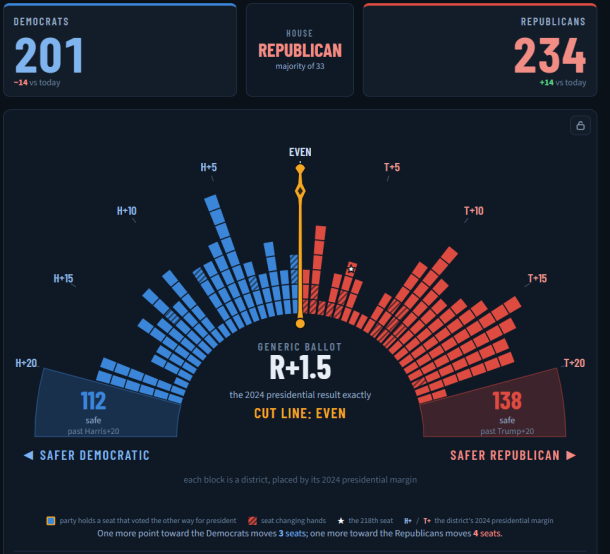
Moving the needle 1.5% to the right for a result of 50-50 reduces the Republican advantage only as far as 228 to 207. To get to the point marked on Mackerras pendulums as “swing required for majority”, the Democrats need to be winning the vote by 53.2-46.8. Under my no-frills settings, the 8.2% Democratic advantage calculated by Ruffini gets the Democrats to 230-205, which isn’t much different from the 233-202 Ruffini gets after pricing in candidate-related adjustments.
The effects of gerrymandering are evident in the relative paucity of Republican seats to be found between “EVEN” and 9% on the right side of the pendulum. Of the six states where maps have been redrawn by Republican-controlled legislatures, the Democrats need swings of more than 10% to gain any of the 30 notionally Republican seats in Texas; 9.2% to gain any out of 23 in Florida; 9.6% to gain any out of 11 in North Carolina; and they stand no chance of gains in Louisiana, Alabama or Tennessee.
Once the swings hit double-digits, gerrymandering starts to backfire: the process involves a party cutting its margins in strong seats to shore it up elsewhere, leaving few truly safe seats to fall back on when the wave becomes tidal. The Republicans have three seats in the 10% to 11% range in Texas; six between 10% and 15% in Florida; and four between 9% and 14% in North Carolina. The Democrats’ retaliatory gerrymander in California, endorsed by that state’s voters at a referendum, locks up Republican support in four of the state’s 52 districts with margins of between 12.6% and 33.0% (plus one Republican marginal at 1.9%), whereas eight seats have notional Democratic margins in single-digits.
Then there is the Senate, which must be reckoned on a case-by-case basis. Senators serve six-year terms over a staggered cycle in which a third are up for election every two years, with two-thirds of the states electing one of their two Senators at any given election. To this are added special elections for seats that have been warmed by placeholders since J.D. Vance resigned his Ohio seat to become Donald Trump’s running mate and Marco Rubio abandoned his seat in Florida to become Secretary of State.
Of the seats not up for election, 32 are held by Democrats, 31 by Republicans and two by independents – the latter caucus with the Democrats, but are balanced somewhat by the maverick tendencies of Pennsylvania Democrat John Fetterman. There is also the possibility, rated at 29% by Polymarket, that Republican incumbent Pete Ricketts will be unseated in Nebraska by Dan Osborn, an independent who says he will not caucus with either party.
The Democrats broadly defined can thus get to 50-50 if they win 16 of the 35 seats up for election, though the Vice-President’s casting vote means parity would little avail them. Seventeen will be required for an effective majority, and 18 for one that is Fetterman-proof. The presumption for most of the past two years has been that this task would be beyond them, as 22 of the 35 seats up for election are Republican-held. However, such has been the decline in the electoral standing of the President and his party that Polymarket now rates the Democrats a 63% chance of pulling it off.
The nine Democratic incumbents seeking re-election are presumably safe, as are the candidates seeking to succeed retiring members in Illinois, Minnesota and New Hampshire. However, the adventurous choice of Abdul El-Sayed to succeed Gary Peters means Michigan requires keeping an eye on, with Polymarket rating El-Sayed’s chances at 69%. The key Republican-held seats are as follows:
North Carolina. The lowest-hanging fruit for the Democrats, being a swing state in which incumbent Thom Tillis is retiring. Polymarket gives Democrat Roy Cooper a 96% chance of gaining the seat.
Maine. A Democratic-leaning state where defending member Susan Collins has held her ground since 1997, having been one of the two most moderate members of the Republican Senate contingent along with Lisa Murkowski from Alaska. Polymarket puts her chances of extending her winning run at 40%.
Texas. The Republicans look to have dealt Democratic candidate James Talarico into the game by dumping incumbent John Cornyn in favour of the tarnished Ken Paxton, in part due to insufficient sycophancy towards the President. Polymarket has Talarico the favourite at a probability of 68%.
Ohio. In a once finely balanced state that Donald Trump won on a double-digit margin in 2024, Polymarket gives Democratic challenger Sherrod Brown a 68% chance against Republican incumbent Jon Husted.
Alaska. Democratic candidate Mary Peltola has lately edged into favouritism against Dan Sullivan in Alaska, with Polymarket rating her a 73% chance. However, intensifying suggestions that the Democratic camp was behind a dumb trick to confuse voters by persuading another Dan Sullivan to add his name to the ballot paper will make late polling especially worth keeping an eye on.
Iowa. Barack Obama won this state twice, but it has come down heavily for Donald Trump three times since. However, the prevailing tide and the retirement of Republican incumbent Joni Ernst means the markets are rating Democratic candidate Josh Turek at nearly level pegging against Republican candidate Ashley Hinson.
Kansas. In a state where the Democrats last won a Senate election in 1932, Polymarket gives Adam Hamilton a 40% chance of unseating Republican incumbent Roger Marshall.
South Carolina. Darline Graham was appointed in July to fill the vacancy created by the death of Lindsey Graham, her brother and inheritor of the family brain cell. Polymarket gives her a 74% chance of having her positioned confirmed by voters ahead of Democratic candidate Annie Andrews.
Florida. Despite the state’s marked shift rightward over the past decade, it might be assumed in the current circumstances that Florida would be in play, but all indications are that Republican incumbent Ashley Moody will be safely returned.
Governor’s races add an extra layer of interest to those who are deeper into the weeds of US politics than I am, but the only one I personally will be paying much attention to is Ohio, where Democrat Amy Acton must defeat Republican Vivek Ramaswamy for the sake of whatever is left of decency in American public life.

Can we please keep this thread for discussion of the mid-terms. The open thread for general discussion is here.
@William, Joni Ernst is the Senator retiring in Iowa, Ashley Hinson is the Republican candidate in that race going up against Democrat Josh Turek.
That was quick. Thanks – corrected.
Last day at work for a few weeks, an annual thing so I can have Cup Week off but it’s always a bonus that there’s a US election on as well. Not that it always goes the way I’d hope
Confident this time but taking nothing for granted
A lot of pieces need to fall into place for the Senate to flip, I hope they do. One state that could cause issues is Minnesota
From Google AI (Steve Kornacki has mentioned it a bit)
According to statements from Senate Majority Leader John Thune and reports from The Hill, a massive statewide welfare fraud scandal has severely impacted Democrats in Minnesota. The scandal has become a significant political liability for the Democratic candidate, Peggy Flanagan, allowing Republican candidate Michelle Tafoya to gain substantial traction in what has become a surprisingly tight race.
Touché
From today’s NYTimes..
https://www.nytimes.com/2026/10/28/us/south-carolina-florida-minnesota-poll.html
Some smokey Senate seats with strong Independents.
Montana
https://dfer.org/policy-polling-memos/montana/montana-general-election-poll-findings/
Nebraska
https://docsend.com/view/hhiqc5yfcc548rdz
William, I’m a bit confused by your numbers. I thought the Dems held 45 seats in the current Senate, plus the two independents, so they only need to win a net 4 seats to get to 51, not 5 as you seem to be suggesting.
Excellent summary William.
It’s an odd sort of election in the Senate, because IMO what the Dems are looking at is a definite win in North Carolina, a highly likely win in Ohio, and then a whole lot of maybes.
Maine: the Dem candidate is pretty poor, and the process by which he became the candidate was an embarrassment. Nobody will be surprised if Collins wins.
Texas: Paxton is simply dreadful, but voting Republican is in the muscle memory of a large majority of white Texans. And continuing subterranean rumours about Talarico’s mysterious disappearance for a significant part of the campaign won’t help matters.
Iowa: the polls don’t look very encouraging for the Dem Senate candidate, who – apart from his admirable performances as a wheelchair-bound paralympian, doesn’t seem to have that much going for him. However, the Dem candidate for governor seems to be a near-certainty to win.
Kansas: Seems a little more likely than Iowa, but my earlier comment re Texas about muscle memory among white voters applies here as well.
Alaska: The suggestions (albeit coming from a disgruntled former staffer) that the Peltola camp were involved in – or, at least, aware of – the stupid Dan J Sullivan manoeuvre are bad news for Peltola. There have been suggestions for some time that all is not well within the Peltola campaign. This one is now looking significantly less likely as a pickup for the Dems.
South Carolina and Mississippi (the latter of which seems more of a possibility than Florida): only if the Dems also win all of the above seats.
Florida: a Dem win here is in the realm of science fiction. But they could conceivably pick up the governorship.
Michigan (currently held by the Dems: At this stage the polling is looking better for El-Sayed than I thought, making me feel glad that I didn’t promise to run through Hobart’s Elizabeth St mall in a clown costume if he won. However, my gut instinct remains that – regardless of the polling might say – his unappealing combination (to all but a few) of being a Muslim, a socialist and having an arrogant demeanour will lead to his electoral demise.
There are clearly a lot of possible permutations re an outcome. If we focus on candidate quality (or lack thereof) on both sides, we get Dem wins in North Carolina, Texas, Ohio and Kansas and a loss in Michigan: a net three seats, not enough to get the Dems beyond 50-50.
But a slightly more optimistic scenario, taking account of the polling data (about which I am highly sceptical), would have El-Sayed holding on to Michigan for the Dems, and also have Peltola winning Alaska and Jackson winning Maine.
By my calculations (which seem to be different to William’s), that set of results would get the Dems plus the two independents to a Fetterman-proof majority of 53-47. (Or 52-48 by William’s calculations.)
I see the Dems getting over the line in the house.
And maybe just maybe in the senate.
Ultimately the Dems will be seated in 2027, but it is going to go through the courts.
Cos Trump and co are not going to accept the results.
Ultimately there will be change.
Buckle up……….
I’m sceptical that the Dems could lose Minnesota, although their candidate, Penny Flanagan, is a long way to the left of the Senator she is hoping to succeed (Amy Klobuchar, who is running for Governor, and is set to win that race by the proverbial country mile).
Flanagan, like El-Sayed, is of course adamant that she is not a DSA candidate. These days, few candidates, beyond Bernie himself and a couple of ratbags in New York seem to want to admit to being part of the DSA.
Says it all, although, if El-Sayed misses out in Michigan, the lefties are all going to claim that it was because the mainstream Dems didn’t support him strongly enough. As Fess pointed out the other day, the most egregious case of anybody in the Dems making things difficult for a nominated candidate is Jasmine Crockett in Texas.
That said, I wasn’t very impressed by this effort from Haley Stevens. She should have waited until after the election.
https://www.yahoo.com/news/politics/articles/haley-stevens-gives-tepid-endorsement-185424086.html
Early voting for mid term election tops 39 millions
HBG
NYT polls about minnesota must be wrong, where Dem Senate candidate Repug candidate by 14 %
Obama said Chaos, Cruelty and corruption to describe Republicans and Trump regime.
meherbaba
A person, who is born muslim, will either become either seriously left wing (which is not to your liking) or an Islamist (which is not to your liking) politician. Muslim will not be a candidate of right-wing or far-right parties in USA, Europe and Australia.
Yes, Abdul el-sayed delivery appears arrogant. That is not helping him.
Whether you like it and accept it or not, Michigan has elected El-sayed. If you want Trump reigned in, Democrats need to win both HOR and Senate.
Larry Saboto. High early voting numbers are due to fear that a lot of people will be prevented from voting on election day.
Murkowski runs towards Dems
Sabato: Alaska: Leans Dem
meherbaba @7:57 am
Didn’t you promise (was it someone else) that they will run naked?
Ven
It wasn’t me. The world isn’t ready (never will be).
Ven
There have been prominent Muslims in the British Conservative Party, most notably Sajid Javid . And (although it’s not on your list) in the Canadian Tories as well. And probably elsewhere.
I wish someone could answer my earlier question about whether the Dems need a net 4 or 5 additional seats to secure a Senate majority. (William presumably, and understandably, must have gone to sleep).
I cannot work out from William’s opening post which of these numbers is correct.
Correction. I’ve misread his original post. He is saying they need 4 seats. I missed that he was including Michigan as an existing Dem seat.
Why would I have even considered the possibility that WB would have been wrong about something like that? My apologies.
An interesting scenario that has been put forward by the renowned “Never Trump” Republican pundit Mike Murphy is that in which the Dems get a big national swing, take the House quite easily, but get no better than, say, 50-50 in the Senate. Murphy has suggested that this is actually the best possible result for the Dems.
It seems to me to be quite conceivable: eg, if the Dem candidates win North Carolina, Ohio and two out of Texas, Kansas, Maine and Alaska (which I have placed in what I think is the order of likelihood), but lose Michigan.
There are pros and cons for such a scenario. Starting with the cons:
– there is a risk of insane Trump appointments to the Supreme Court (but see below)
– the Dems would lose the opportunity of getting an impeachment or some other important veto-proof vote through the Senate with the support of some Republicans (but surely this is highly unlikely)
The main pros are
– if the Dems don’t achieve a clear majority in the Senate, Trump might not go quite as postal in terms of trying to overturn the election result. Which I think is better for all concerned
– every Republican senator who depends on the support of normal Republican voters, along with JD Vance, would be faced with a Hobson’s choice every time a crazy Trump policy or appointment comes before them (including appointments to the Supreme Court of the calibre of Emil Bove or Aileen Cannon). If they vote for such things, they will alienate an important part of their electoral base. If they vote against them, they will incur the anger of Trump and his MAGA supporters. Vance will find this situation particularly problematic: he will have to own every pretty much every Senate vote.
So, if the Dems don’t quite make it to a Senate majority, don’t despair. Any narrowing of the existing Republican majority will be helpful for them going forward.
The Dems taking the House seems like a pretty safe prediction, given they are 8-9% in the generic ballot, and they only need a handful of seats to win a majority. That said, the mid-decade gerrymandering wars probably give the GOP a small advantage, so I’ll be more comfortable with that prediction after next Tuesday.
The Senate is fascinating. It’s looks all but certain that the Dems will pick up North Carolina and Ohio, and they look like they will hold all of their current states. That gets them to 49, after which the road is a bit harder. Not at all convinced they’ll win Maine, Collins is the great survivor and the Dems have candidate issues. Texas, Iowa, Alaska and Kansas are all possible, but one suspect that they will win either all of then or none of them. South Carolina and Mississippi are smokies (big black populations in both), but Florida seems to be out of reach for the Dems these days.
The Indies in Montana and (especially) Nebraska are a bit of a wild card, but I suspect that in the end they will fall short.
If pushed for a prediction, I’m going to say there will be a 50/50 Senate come January.
I hope the polls are wrong like last time and democrats are undervalued and real life voting is a larger gap (with dems winning more)
I think Dems will be winning the senate. Trump isn’t on the ballot. He is a very unpopular president. Polling has good track record for midterms when he isn’t on the ballot. Generic ballot pushing double digit DEM margins.
FWIW, my assessment of the latest polling is
Michigan: El-Sayed seems to be pulling away. The two latest polls (CBS and Detroit News) have him at 51-44 and 51-45 respectively. My decision not to promise to run around nude or in a clown suit if he wins is looking better and better.
North Carolina: Cooper is ahead by the proverbial country mile.
Ohio: Rather too close for comfort. There seems to be a swing towards Acton in the Governor’s race (hardly surprising), while the Senate race seems to be tightening. Perhaps there are some normie Republican voters who don’t feel that they can vote for both Acton and Brown, and have now had their hand forced to vote for Acton because of Ramaswamy’s dreadful ad. Also, if you look at his main messages, Brown is a extremely retro sort of candidate: I would personally say way out of date.
Maine: Jackson ahead, but Collins is too close for comfort.
Texas: Talarico still looking pretty good.
Kansas: A real coin toss, although there doesn’t seem to have been any new polling for a couple of weeks.
Alaska: Also not much recent polling. Peltola is a little ahead on the basis of what we’ve seen.
Iowa: Hinson seems comfortably ahead. No hope for the Dems.
Florida: Dems no hope at all.
South Carolina: Polling is close, but it’s a profoundly Republican state, so one has to be sceptical.
Mississippi: I think people suggesting a Dem win here need to think about reducing their THC intake.
So it’s looking like the Dems are certain to retain Michigan and gain North Carolina, and that they still have a realistic chance of gains in four other states, plus an outside chance in South Carolina. So somewhere in the range of 48-53. Quite conceivably 50-50 (Dems win North Carolina, Texas and one other, as well as holding Michigan).
“ Governor’s races add an extra layer of interest to those who are deeper into the weeds of US politics than I am, but the only one I personally will be paying much attention to is Ohio, where Democrat Amy Acton must defeat Republican Vivek Ramaswamy for the sake of whatever is left of decency in American public life.”
Nice one William!
But anyway, I expect the Dem’s to outperform the polls slightly like in 2022. The enthusiasm gap is huge, and we are already seeing fundraising and support for Democrats not seen since 2008 which was really the last solid blue year (2018 leaned Dem, but not as much as this)
Looking over the seats, I think I can get Dems to 55-56 seats, it is optimistic but I do see a path, Republicans aren’t really motivated to vote this midterm since their president is a lame-duck, lack of enthusiasm for JD Vance in 2 years, and the polling likely makes some republicans think “why bother”? Plus some of the presidents core supporters also don’t believe in the integrity of elections so some may “boycott”
North Carolina: Zero question about this one, as the blog says, a 96% chance. I even heard reports of Cooper volunteer moving to South Carolina to campaign because of how confident they are about this seat. (+1)
Ohio: If you asked me even 6 months ago I would have said no chance the former defeated senator would be able to make a comeback. However events have turned for the worse for Republicans even before the disgraceful candidate for governor made his ad.
The irony here is Sherrod Brown is likely to defeat a man who was appointed by the man he also defeated 20 years ago (+2)
Maine: People are right, Susan Collins has defied odds before and the Platner saga certainly re-ignited her campaign and kept it alive, and personally although I want her to lose, I would not be upset if she wins because she is one of the few “more moderate” Republicans remaining. And she has gotten some bills watered down. But the senate majority is on the line and I suspect while Jackson is lacklustre, people will vote not for him personally, but to put the democrats in control of the senate. Possibly won’t be called on the night but the margin could be anything from a narrow Jackson win to a large defeat for Collins. (+3)
Texas: This one is basically a goner for Republicans, the only reason I don’t rank it higher than Maine is simply because we don’t know how much Latino’s will come out for Talarico (turnout wise) if we see 2018 levels, I could see him winning by 3-4% statewide but if Paxton does better than expected in that demographic and assuming governor Abbott wins who might help Paxton slightly, then for Talarico it all comes down to a massive improvement and high turnout in the cities.
Kamala Harris only won Harris county (the irony) by 5%, Talarico will need a 15+ but more like 20% win in that county in this scenario to offset any shortcomings in other parts of the state, but Tarrant county will be key here, but Talarico should win simply because of how awful Paxton is. (+4)
Alaska: I had this one higher before but while Peltola started off really strong, she is starting to slip away here, but the governors race, and the president extreme unpopularity in the state and the lack of enthusiasm for Sullivan should get Peltola across the line despite Murskowski supporting her Republican colleague. (+5)
Kansas: I put this higher than Iowa because Adam Hamilton has ran an almost perfect campaign, he is perhaps the most talented candidate Democrats have this cycle, and the huge problems for senator Marshall suing former patients who didn’t pay the unaffordable medical bills is giving Republicans headaches here, however the Governors race is leaning Republican despite this year being more blue than 2018 because Kansas does not like keeping the same party in Topeka more than 2-terms.
So will Masterson help Marshall? Probably a bit, but Hamilton would have preferred if Governor Kelly was allowed to run for a 3rd term because that would have helped him even more. But due to the polling averages and how bad this year is looking for Republicans, I barely give this one to the Democrats by a whisker but would not be surprised if the state sticks to it’s republican DNA (+6)
Iowa: This one is harder than all other above, because despite Trumps low approval, and the governor’s race leaning Dem (the only reason Turek has a shot is due to Sands performance) I think Sand needs to win by at least 7-8% to pull Turek across. But unlike all Republican senate candidates in the states I mention apart from Susan Collins, Hinson is actually running a much better campaign than the rest of them, she has kept the campaign much more respectful than the others although she still is not a good politician.
Gut instinct tells me she barely wins so Democrats would end at 53-47, however something tells me as I said at the outset that the Dems will do better than expected, i would not be shocked if this is the 7th gain for them, although if that happens this race probably will be in recount territory. (+7)
South Carolina: this is a true dark horse, nobody really knows this one, we can only rely on the fact this is still a ruby red republican state, but at the same time Darline Norlane Graham has ran an awful campaign and it’s giving Democrats excitement and confidence they can elect the first official since the legendary senator Fritz Hollings left the senate in 2005.
This will be close, i expect Norlane to unfortunately barely hold on by a point, but this one could truly be the moment of the night if it falls which I think there is a decent shot, if so then that is (+8) and this will be the biggest democratic midterm wave since at least 1974, but short of 1958.
Nebraska: Senator Ricketts was not a great governor but he is facing an independent and not a Democrat, but he did lose to one 20 years ago for the other senate seat, but since Senator Fischer won 2 years ago against Osborne I am not convinced Osborne can win this time despite the blue wave since Osborne is not a Democrat and even if he wins this would be the (-9) for Republicans and not classified as a gain for Democrats.
Any other seats mentioned such as Mississippi is a bit silly, I don’t expect that will be close. Overall, anything from 6-9 seats lost by Republicans seems the more likely outcome. This president is more unpopular than President Bush was 20 years ago.
It will be interesting to see after this election, how much of an impact that Trump talking about the asses of Nicki Minaj and John Husted has affected the Republicans chances and what lessons they will take from this.
While I agree that Mississippi is a real long shot, it’s not quite the no-hope that it might appear. The black population of MS is 37%, the vast majority of whom vote Democrat, so any Dem candidate only needs to peel off a small proportion of white voters if black turn out is high enough. Even in 2020 (when of course Trump was on the ballot), Hyde-Smith only won by 10 points (54-44), so the state is not as rock solid Republican as, say, neighbouring Tennessee (which went 62-35 in 2020). There has been next to no polling in MS (the only poll this cycle was one back in April which had Hyde-Smith up only 47-44), so we’ve got no real data to work with. I’m not saying a Dem win is especially likely, but it’s not as outlandish a thought as it might first appear.
Still think the senate will be about 50-50.
But let’s see what happens if I’m wrong;
If I’m wrong about Michigan, Minnesota, Maine, and South Carolina, dems get to 54 seats.
If I’m wrong about Texas, Alaska, Iowa, and Ohio then republicans get to 54 seats.
If I’m only wrong about Michigan and Minnesota, dems get to 52 seats.
(By the way, I think that nyt Minnesota poll looks a little “sus”
The favourability ratings completely contradict the voting intention)
The Murdoch media are currently blowing out a lot of smoke around Ilhan Omar.
For instance, this article
https://nypost.com/2026/10/28/us-news/ilhan-omars-muslim-husband-disgusted-by-dirty-dandy-brother-she-wed-coming-to-live-with-them-source/
which is certainly full of new detail, accurate or otherwise.
Is there any fire behind the smoke?
Snopes.com (which is certainly not a right-wing site) seems to be gradually walking back its previously unequivocal support of her denial that she married her brother in order to get him into the US.
https://www.snopes.com/news/2026/10/27/ilhan-omar-married-brother-name-dispute/?utm_source=mail.snopes.com&utm_medium=referral&utm_campaign=did-ilhan-omar-marry-her-brother-we-have-the-facts-premium
A big factor in Snopes’s growing uncertainty would seem to be the claims in the NY Post that, contrary to past statements by Ilhan Omar and others, her father was not named Nur Omar Mohammed, but rather Nur Said Elmi. This potentially matters because there is no doubt that the man she married (in between her two weddings to her first husband) was named Ahmed Elmi. The NY Post, Fox, etc. are going very hard on this, which I doubt they’d do if they didn’t have some evidence. I’d say that they (and/or the Federal Government) seem to have someone connected to the family who is feeding them information. Whether or not that information is true will no doubt become clear in due course.
This builds on the growing sense of danger I felt when I saw that her latest answer to the question of whether or not she married her brother was “Not to my knowledge.” Which, let’s face it, is extremely weak.
My sense is that she’s in a fair bit of strife here, and that the story might not end well for her. I certainly don’t want to see that happen: I don’t agree with most of her ideas, but she has clearly been an effective politician and represents her constituency well. As with Bolsonaro jr, I’m uncomfortable about governments driving their political opponents out of the country (or worse).
Arange, Rogers didn’t win in 2024 in an R+2 year, why on earth would he win this year?
Plus Minnesota is no chance, Trump didn’t even win the state. And Klobuchar will carry Peggy over easily
Ya’ll act as if Ilhan Omar is the candidate in Minnesota
Daniel Tsays:
Thursday, October 29, 2026 at 1:58 pm
“Arange, Rogers didn’t win in 2024 in an R+2 year, why on earth would he win this year?”
In short, Gary peters is not contesting the election and democrats have an unpopular candidate that democrats themselves are also divided on.
It’s a similar story for Minnesota
Arange, but why would Republicans beat the polls? There is a large enthusiasm gap. The president is very unpopular in those two states. There is no appetite for a republican controlled senate in those two states. And 2024 was also an open seat and Republicans failed to take it (Michigan)
El Sayeed is no Mehmet Oz, people don’t vote against their candidate because of their faith. This is not 1928 with Al Smith.
Republicans also have not won a senate race in Michigan since 1994, and Minnesota since 2002 (although 2008 was a bit flawed)
If Harris was president, I would absolutely agree that those two would be gains.
Arange
Of course it’s an absurdly good result for Flanagan, although broadly consistent with Klobuchar’s polling in the gubernatorial race. (I just love the word gubernatorial”.)
But the key point is that, after a long period of Flanagan being around 3-4 per cent ahead, there has been a shift and it would appear to be in her direction. Likewise – looking at the broader region – the polling for Klobuchar, Crowley in the Wisconsin gubernatorial race and El-Sayed in Michigan. This could be indicative of disgruntled Democrats in a number of states slowly returning to base. Or, as with all the polling up to now, it could be based on sampling errors. We’re going to find out which in less than a week.
Daniel Tsays:
Thursday, October 29, 2026 at 2:11 pm
“Arange, but why would Republicans beat the polls?”
I don’t know, perhaps democratic enthusiasm is mostly limited to red states.
I focus on predicting the winner instead of predicting polling error.
Daniel T
Amir Hassan (who had a Muslim-sounding name but wasn’t even a Muslim, and whose opponent had officially pulled out of the race) says hi!
https://www.yahoo.com/news/politics/articles/trump-backed-black-conservative-lost-184911023.html
Meher, that was a republican primary, Trump‘s most dedicated supporters care but most moderate and swing voters and Progressives do not care about a candidates faith or lack here of
Daniel T
These days, left wing people don’t much like Jewish people, and appear to be a bit negative towards committed Christians. For some reason, they seem to be pretty keen on Muslims, notwithstanding the deep social conservatism of that the religion as it is generally practiced.
I don’t know what swing voters think. I suspect many swing voters in the US haven’t yet entirely gotten over 9/11. But the polling for El-Sayed is looking good as of today, so perhaps they don’t care all that much (or, I suspect, care about other things a lot more).
Meher
“These days, left wing people don’t much like Jewish people”
This is absolutely not true.
You would have to reconcile that claim with the popularity of Bernie Sanders, the existence of Jewish Voice For Peace, etc
It’s typical for an electoral backlash against the party in the White House, especially in a President’s second term, and while I don’t see any evidence of circumstances that might buck this trend (like in 2002) and Trump’s popularity has tanked enough to reasonably expect a backlash, some questionable candidate choices and pointlessly distracting rhetoric might make some races a bit more bumpier than need be (unless the “wave” is strong enough to sweep them in regardless.)
I have mostly been ignoring polling this time around because I don’t have time for that kind of stuff and because of its variable unreliability at times but, looking at the broader outlook of what I have paid attention to and the historical context, I’ll say both houses will flip but I have no idea what the margins will be. I am sure whatever the result, it will confirm everybody’s priors.
Mehmet Oz is not a visible Muslim in the same way as El-Sayed is (in fact I’d go so far as to argue that he’s quite nominal in his faith based on his public persona, but of course who knows behind closed doors).
bonza
I should have said that left wing people don’t much like religious Jews. I understand that Bernie is an atheist.
JM from Qld
Oz claims to be into Sufism and his wife’s Swedenborgism. (I do love a bit of Swedenborgism: it’s a very entertaining sort of religion.)
Meher baba
“I should have said that left wing people don’t much like religious Jews.”
And I would still dispute that, sorry. I am simply not going to be gaslit into believing that the left’s broad disgust with Israel’s live-streamed military actions equates to a blanket dislike of Jews or Judaism.
Just clarifying my earlier post
I meant to say that it’s typical in a midterm election.
Some tea leaves in the early voting:
1.significant numbers of low propensity Democratic voters along with huge increases in Latino voters, Texas is off the charts, but significant increases just about everywhere
2. Significant increases in black voting numbers across the South
Late polls suggest:
1. Michigan Senate seat will be held by the Dems by over 5%2.
2. Minnesota will be fine for the Dems
3. South Carolina is moving into toss up territory.
CNN’s somewhat upbeat assessment of the Dems’ chances in the midterms:
https://www.youtube.com/watch?v=Y0NWadgXmS0&t=837s
Bonza
And that brings us back to the mystery of the obsessive focus of the Western political left on Israel and Palestine, to the seeming exclusion of the plight of the Ukrainians, the peoples of Georgia, the Muslims of the Russian-controlled Caucuses, the peoples of central Africa, the Rohingyas, Arab Christians, Yazidi, Tibetans, the Uighur, the traditional owners of the Amazon and even the Indigenous people of Irian Jaya (who used to receive a lot of attention from the Australian left, but no longer). Quite an enigma. But no more from me on this topic for fear of pissing off the great WB.
Re the fake Dan Sullivan thing in Alaska, has any pointed out yet that under RCV as they call it, Alaska and Maine are the states where this tactic is going to have clearly the LEAST effect on the final result??